Yes — brand entity presence improves AI search recognition. Knowledge graph entries and Wikipedia mentions help AI systems identify your brand as a citation target.
58 sources reviewed · Confidence: High (12.0/35) · Covers all
Key findings
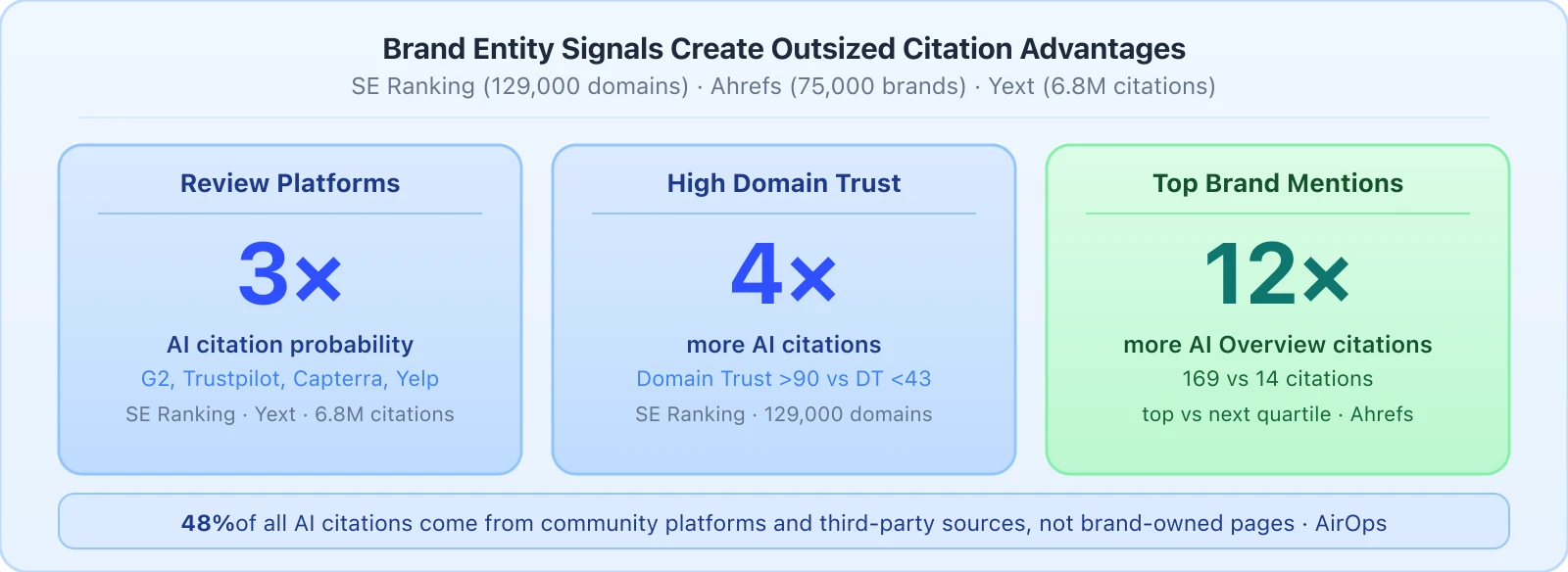
Brands in the top 25% for earned web mentions receive 169 AI Overview citations on average vs 14 for those in the next group: a 12× gap driven by entity strength, not Domain Rating (Ahrefs, 75,000 brands)
Domain Trust >90 earns 4× more AI citations than DT <43; 48% of AI citations come from community platforms and third-party sources (SE Ranking, 129,000 domains; AirOps)
Active review platform profiles (G2, Trustpilot, Capterra, Yelp) produce 3× higher AI citation probability: directories account for 42% of total AI citations across 6.8M citations (SE Ranking; Yext)
LLMs are trained on text, not links. Which means the web's most powerful authority signal for AI search is not who links to you: it's who mentions you. An Ahrefs analysis of 75,000 brands found that branded web mentions correlated with AI citation rates at 0.664–0.709 Spearman, while Domain Rating correlated at 0.266–0.326. YouTube channel mentions were even stronger at 0.737.
That suggests cross-platform entity presence, not just editorial mentions, is what AI systems are responding to. The practical implication: if your brand has strong backlinks but weak editorial and community coverage, you have a GEO gap that no amount of on-page optimisation will close.
What are brand entity signals for AI search?
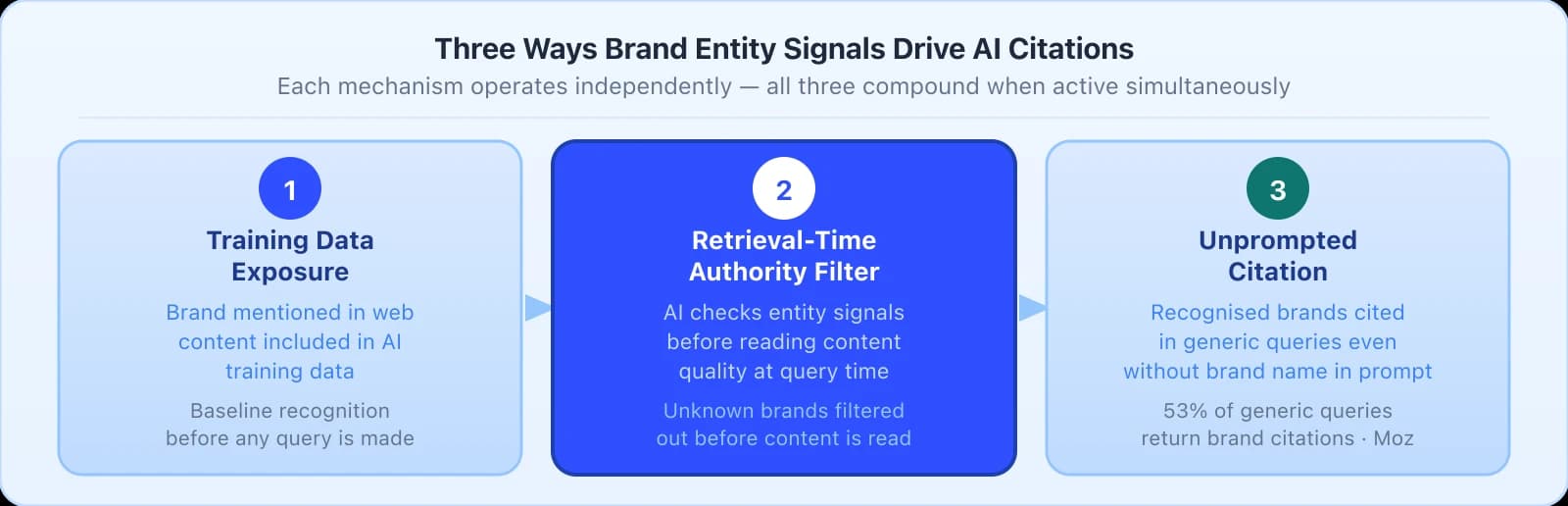
Brand entity signals are the off-page markers that help AI systems recognise your brand as a citation-worthy source in a specific topic area. They operate through three mechanisms: training data exposure (LLMs learn which brands are associated with which topics from the text they train on), retrieval-time authority filtering (AI search systems use brand recognition signals to filter candidates before evaluating content quality), and unprompted citation (brands with strong entity signals are surfaced even in queries that don't name them: Moz found 53% of generic category queries return brand citations). You build entity strength through editorial coverage, community presence (Reddit, LinkedIn, YouTube), and consistent brand representation across directories and review platforms.
Do brand entity signals improve AI search citation rates?
Yes: brand entity signals are the single strongest predictor of AI citation rates in the data.
The Ahrefs finding quoted in the introduction bears examining more closely. In an Ahrefs analysis of 75,000 brands, the top quartile by earned mentions received a median 169 AI Overview citations. The next quartile received 14. That's a 12× gap between brands that have built genuine editorial presence and those that haven't: driven by brand entity strength, not Domain Rating.
An SE Ranking study of 129,000 domains found a parallel pattern. Domains with Domain Trust above 90 earned 4× more AI citations than those with Domain Trust below 43. Domain Trust reflects the breadth and quality of a brand's external web presence: closer to brand entity strength than traditional link count.
Who is actually getting cited
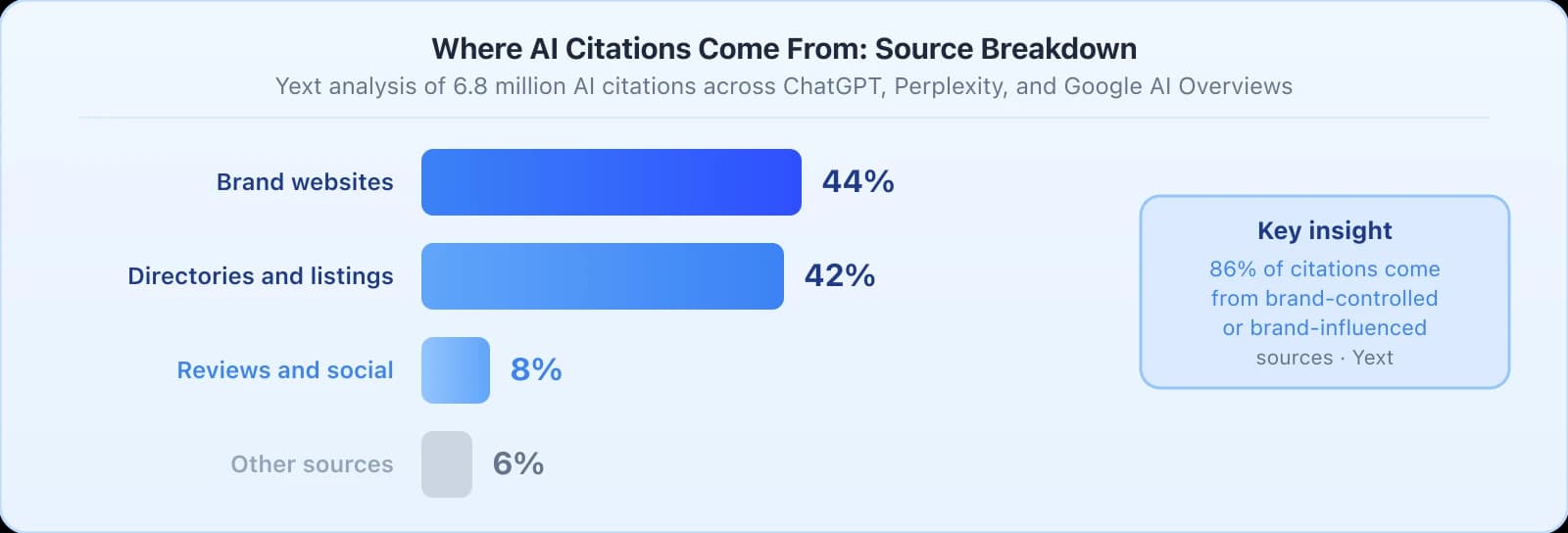
An AirOps analysis found 48% of AI citations come from community platforms and third-party sources: 85% of brand mentions in AI responses come from third-party pages, not the brand's own domain. A Yext study of 6.8 million citations found brand-managed or brand-influenced sources account for 86% of citations, broken down as: 44% brand websites, 42% directories and listings, 8% reviews and social.
That 42% from directories is significant. For recommendation queries ("best X for Y"), Yext found 46.3% of citations came directly from directories and review platforms, not editorial publications, not brand websites.
The review platform signal
An SE Ranking analysis found brands with active profiles on Trustpilot, G2, Capterra, or Yelp show up in AI responses at 3× the rate of those without profiles. These platforms are in the AI training corpus and in the retrieval pool. A profile with substantive reviews is a cross-referenceable entity record: something AI systems can use to confirm your brand's association with a category.
Topical authority as a citation multiplier
An arXiv study found that for topics where AI systems have limited pre-training data, retrieval rank directly determines citation outcome. Brands consistently associated with a narrow topic area, not just mentioned in it: are cited more reliably than larger brands with broader but shallower topic coverage.
This is the topical authority dynamic in AI search: consistent, specific brand-topic association across third-party sources (editorial, Reddit, LinkedIn, YouTube) creates a signal that AI systems respond to in retrieval, independently of the brand's overall size or domain authority.
What the evidence doesn't prove
The Ahrefs, SE Ranking, and Yext studies are observational. They show what brands with high AI citations look like, not that building those signals caused the citations. Strong brands tend to simultaneously have better editorial coverage, better review profiles, and better content: the signals compound.
One finding complicates the review platform picture. A December 2025 Yext study found review platform citations declined from 8% (measured in October 2025) to 5.5%, while brand-controlled sources gained share. The optimal mix of entity signals is evolving as AI search platforms update their retrieval logic.
How to build brand entity signals for GEO
5 platform-official statements plus 53 corroborating sources back this finding: high confidence across all. Act on this now: it's one of the better-evidenced tactics in the database. Authority signals take months to build and are difficult for competitors to replicate quickly. This is a long-term investment that compounds: the earlier you start, the wider the moat.
Implementation
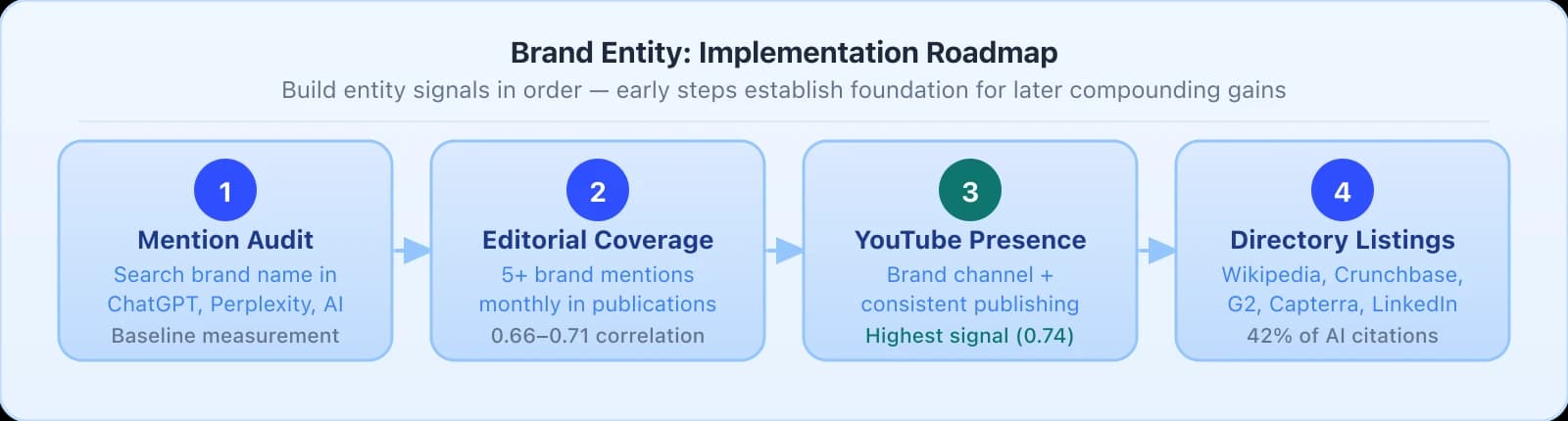
Run a brand mention audit: search your brand name in ChatGPT, Perplexity, and Google AI Overviews. Note which sources are cited: these are the authority signals currently shaping your AI visibility.
Target at least 5 "unlinked brand mentions" per month in authoritative publications: editorial mentions without links still train LLM brand recognition.
Build a YouTube channel presence. Video content from YouTube appears in AI citations disproportionately relative to video's share of web content.
Get listed in relevant industry directories and databases: Wikipedia, Crunchbase, G2, Capterra, LinkedIn Company pages are all indexed heavily by AI training pipelines.
Frequently asked questions
Does establishing your brand entity help you get cited in AI search results?
Yes: high confidence across 58 sources (score: 12.0/35). 5 are platform-official: the strongest possible signal. No contradicting evidence found.
Does establishing your brand entity work for ChatGPT, Perplexity, and Google AI Overviews?
The research covers all. Platform-official guidance exists for this tactic: the strongest possible confirmation. Results may vary by platform as AI systems evolve: verify against current documentation before acting.
How was the evidence collected?
The 58 sources use official platform documentation and controlled experiments and observational studies and meta-analysis. 9 sources are academic or peer-reviewed. All sources are listed with direct links in the Sources section below.
Should I prioritise Establish your brand entity over other GEO tactics?
Given the high confidence rating and platform-official backing, yes: this is one of the better-evidenced tactics in the database. Authority signals take months to build and are difficult for competitors to replicate quickly. This is a long-term investment that compounds: the earlier you start, the wider the moat.
How this score is calculated
Each source is weighted by tier, independence, and how recent it is. Open the breakdown to see every source and how the score has changed over time.
Sources
Optimizing Your Content for Inclusion in AI Search Answers
Platform officialMicrosoft·
Google Updates Site Reputation Abuse Policy
Platform officialGoogle·
Search profile publishers updates
Platform officialGoogle·
A new profile to help publishers and creators highlight their work on Search
Platform officialGoogle·
AI Inside Podcast — Liz Reid Interview
Platform officialAI Inside (YouTube)·
AI Tools Recommend Brands But Cite Other Sites: Ecommerce Citation Analysis
IndependentShero Commerce·
Research: Google AI cites Facebook in 19.5 million AI answers
IndependentBrightEdge·
Does Topical Authority Matter in AI Search?
IndependentGrowth Memo (Substack)·
AI Tools Recommend Brands But Cite Other Sites
IndependentShero Commerce·
IndependentClovion AI·
6sense B2B Buyer Experience Report 2025
Independent6sense·
IndependentGrowth Memo·
The Downstream Impact of AI Visibility
IndependentSimilarweb·
Brands mentioned on four or more platforms are 2.8 times more likely to appear in ChatGPT responses
IndependentThe Digital Bloom·
How Consumers Navigate High-Stakes Purchases in AI Mode vs. Traditional Search
IndependentGrowth Memo·
How Much Can You Influence Which Brands ChatGPT Recommends?
IndependentVisible·
2026 B2B AI Buying Behavior Analysis
IndependentLoganix·
2025 AI Visibility Report: How LLMs Choose What Sources to Mention
IndependentThe Digital Bloom·
New Research: AIs are highly inconsistent when recommending brands or products
IndependentSparkToro / Gumshoe.ai·
Answer Engine Optimization: Strategic Content Architecture for AI-Powered Discovery and Citation
AcademicLeading Minds / Academic Thesis·
What if the Best GEO Strategy Is the One You Stopped Investing In?
IndependentSeer Interactive·
GPT-5.4 vs GPT-5.3 ChatGPT Citation Study
IndependentWritesonic·
AI Engines Comparison: How ChatGPT, Perplexity, Google AI Mode, and Claude Cite Sources
IndependentWhitehat SEO·
Q1 2026 AI Citation Trends Report
IndependentTinuiti / Profound·
What Our AI Mode User Behavior Study Reveals About The Future Of Search
IndependentSearch Engine Journal·
Visibility in ChatGPT and LLMs
IndustryUberall·
ChatGPT 5.3 / 5.4 Citation and Crawl Analysis
IndustryResoneo
AI Traffic Trends: Gemini vs ChatGPT Referral Traffic Study
IndustrySE Ranking
Quarterly AI Traffic Report — Q2 2026
IndustryAdobe Digital Insights·
The Complete Guide to Off-Page AEO/SEO AI Visibility
IndependentBeeby Clark+Meyler·
What is AI Reading? Generative Pulse Report
IndustryMuck Rack·
The 2026 State of AI Search: How Modern Brands Stay Visible
IndustryAirOps·
We Analyzed 250 Million AI Search Results — Here's What We Found
IndustryProfound·
We Analyzed 129,000 Domains: Here's What Predicts ChatGPT Citations
IndustrySE Ranking·
AI Visibility 2026: What Gets Brands Cited
IndustryNoBSMarketplace·
AI Search SEO Statistics 2026: The Definitive Collection
IndustryDigital Applied·
AI Citation Behavior Across Models
IndustryYext·
IndustryReboot Online·
July 2025 AI Search Weekly Insights
IndustryLinkedIn·
AI Citations, User Locations, & Query Context
IndustryYext·
Last reviewed: Evidence score: 12.0 / 3558 supporting · 0 contradicting
Related analysis