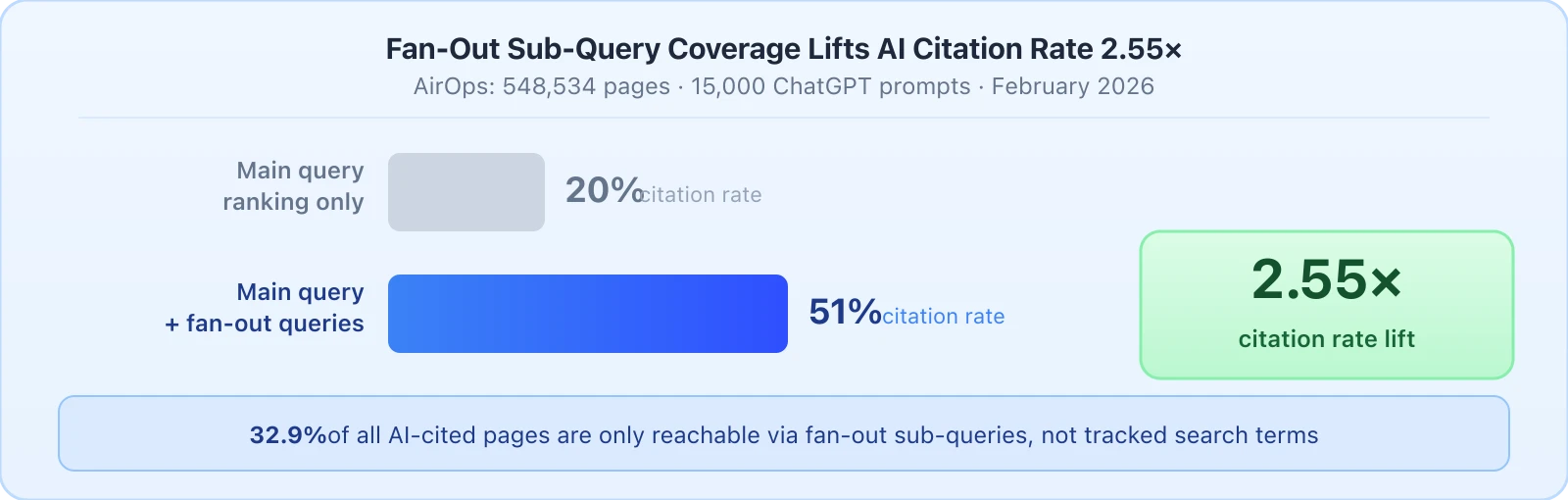
Yes — fan-out queries drive 32.9% of all AI citations. 95% of ChatGPT fan-out sub-queries have zero search volume; brands missing them miss one-third of citations.
23 sources reviewed · Confidence: High (12.0/35) · Covers chatgpt, perplexity, google-aio
Key findings
32.9% of AI-cited pages discoverable only through fan-out sub-queries: invisible to traditional keyword monitoring (AirOps, 548,534 pages, 15,000 prompts)
Pages ranking for main query plus 1+ fan-out queries achieve 51% AIO citation rate vs 20% for main-query-only rankers; 95% of fan-out sub-queries have zero search volume (AirOps)
ChatGPT generates 25+ query variations per prompt; pages with 26–50% fan-out coverage are cited at 38.2% vs 34% for 100%-coverage pages (AirOps)
Keyword tools don't show 95% of the queries AI uses to find content. When ChatGPT processes a user prompt, it rewrites it into 25+ sub-queries before retrieving any content: and 95% of those sub-queries have zero traditional search volume. An AirOps analysis of 548,534 pages across 15,000 prompts found 32.9% of AI-cited pages were discoverable only through fan-out sub-queries, not the original user prompt. If you're optimising for primary keywords only, you're covering at most 67% of the AI citation surface.
What is fan-out query coverage for AI search?
Fan-out queries are the multiple sub-queries AI systems generate from a single user prompt before retrieving content. Google's Query Fan-Out mechanism: documented in a Google patent: decomposes user queries into parallel sub-queries covering related subtopics, adjacent questions, comparison angles, and follow-up considerations. ChatGPT's equivalent generates 25+ unique query variations from one prompt. The content that gets cited is the content that ranks for these sub-queries, not just the original keyword.
Fan-out query coverage matters because AI citation has become a multi-query retrieval problem, not a single-keyword ranking problem. A page optimised for one target keyword can rank well for that keyword but have zero coverage of the adjacent fan-out queries that determine whether it appears in AI responses. An AirOps study found that pages ranking for both the main query and at least one fan-out query achieve a 51% AI Overview citation rate, versus 20% for main-query-only rankers. Building content that answers the range of related questions is how you expand that coverage.
Does fan-out query coverage improve AI search citation rates?
Yes: fan-out query coverage predicts AI citation rates more strongly than primary keyword ranking.
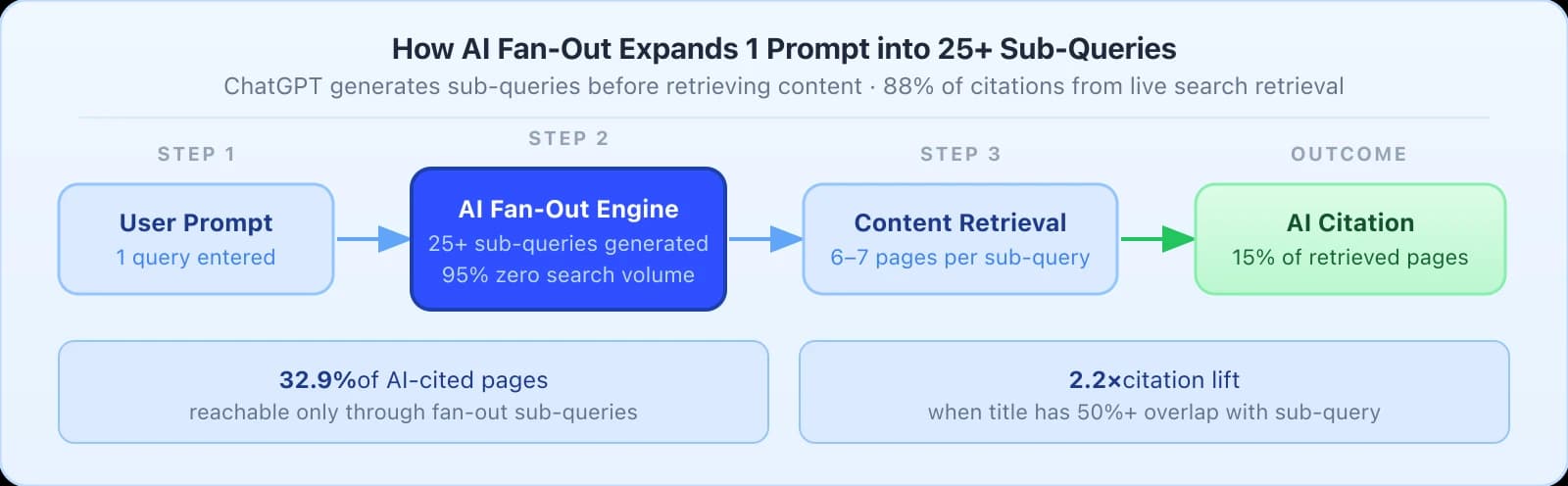
ChatGPT processes a prompt by expanding it into sub-queries before retrieving any content. It generates 25+ unique query variations from a single user prompt. Citations then come from pages ranking for these expanded queries, not just the primary keyword.
The effect is large. An AirOps analysis of 548,534 retrieved pages across 15,000 prompts found 32.9% of cited pages were discoverable only through fan-out sub-queries: invisible through traditional keyword monitoring.
95% of those sub-queries had zero traditional search volume. Keyword tools measure what humans search. They don't measure what AI systems query when composing answers.
Fan-out coverage multiplies citation probability
An AirOps study compared pages by their fan-out query ranking profile. Pages ranking for both the main query and at least one fan-out query achieved a 51% AIO citation rate versus 20% for main-query-only rankers. That's more than a 2× lift from covering adjacent subtopics.
The same study found that pages covering 26–50% of ChatGPT's fan-out sub-queries were cited at 38.2%: while pages covering 100% were cited at only 34%. Focused coverage of the right subtopics beats exhaustive coverage of all subtopics.
Single-query optimization harms adjacent query performance
This is the counterintuitive finding. Optimising a page purely for one target query induces gain allocation skew: the target query improves at the expense of related queries. Cross-query citations fall.
The implication: pages optimised for a single keyword are actively penalised in AI retrieval for adjacent queries their topic logically covers. A hub-and-spoke content structure addresses both the primary query and the fan-out queries it generates, without the trade-off that single-query optimisation creates.
Only 15% of retrieved pages make it into final answers
ChatGPT retrieves approximately 6–7 pages per 1 that appears in a final answer. 85% of retrieved pages are discarded. Getting into retrieval requires fan-out coverage. Getting from retrieval to citation requires something else: structural answer-extraction patterns: direct answers early in the page, title-query alignment, readability.
An Ahrefs analysis of 1.4 million ChatGPT prompts found 88% of ChatGPT citations originate from live search retrieval, not training data. The pages getting cited are pages ranking in traditional search for the specific fan-out query, then clearing content quality filters.
AI citation surfaces are platform-specific
Fan-out query behaviour varies by platform. Google AI Mode cites only 12% of top-10 organic results: versus 38% for Google AI Overviews. Despite 86% semantic answer overlap between AI Mode and AI Overviews, they share only 13.7% of cited URLs. Sites outside the top 10 can earn AI Mode citations through fan-out query coverage on adjacent subtopics.
ChatGPT referral reach peaked at 260,000 unique domains monthly in October 2025, then contracted to 170,000 by February 2026 (Semrush). But queries per session increased from 1.21 to 1.75: 50% more fan-out opportunities per conversation. Brands covering subtopics comprehensively are better positioned for multi-turn citation.
What the evidence doesn't prove
The AirOps data is observational: it shows what fan-out coverage looks like for pages that are cited, not a controlled experiment proving that building fan-out coverage causes citations to increase.
The finding that 26–50% coverage outperforms 100% coverage is counterintuitive and may reflect selection effects: pages that deliberately focus on specific subtopics may simply be higher quality overall than pages attempting to cover everything.
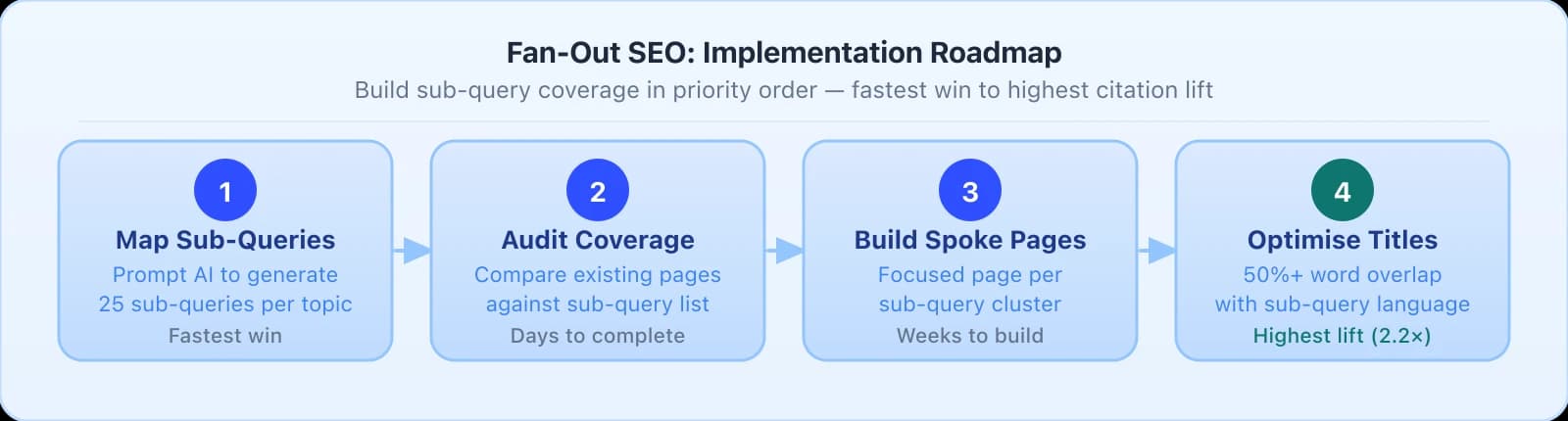
The practical action is clear regardless: map the sub-queries AI generates for your primary topics, audit which you have coverage for, and build focused pages for the highest-value gaps.
How to optimise content for AI fan-out query coverage
2 platform-official statements plus 21 corroborating sources back this finding: high confidence across chatgpt, perplexity, google-aio. Act on this now: it's one of the better-evidenced tactics in the database. This scales with your publishing output. Every new piece of content is an opportunity to apply it: start with your highest-traffic pages and work backwards through your archive.
Implementation
Map the fan-out sub-queries AI systems generate from your target topics: prompt ChatGPT or Claude with "generate 25 sub-queries an AI would generate when answering questions about [your topic]". These zero-search-volume queries are what 32.9% of AI-cited pages are discovered through (AirOps, 548,534 pages).
Audit your existing content against the generated sub-queries: note which sub-queries have a matching page and which are gaps. Pages ranking for the main query plus at least one fan-out query achieve 51% AI Overview citation rate versus 20% for main-query-only rankers (AirOps).
Build focused spoke pages for the highest-value sub-query gaps: one page per sub-query cluster, not one comprehensive page covering all angles. AirOps found pages covering 26–50% of fan-out sub-queries outperform pages covering 100%, because focused pages rank more precisely for their specific sub-query.
Write spoke page titles to match the specific sub-query language exactly: an AirOps study found 50%+ word overlap between page title and AI query achieves a 2.2× citation lift. The spoke page's title should be the sub-query itself, not a branded or creative variant.
Frequently asked questions
Does covering fan-out zero-volume queries help you get cited in AI search results?
Yes: high confidence across 23 sources (score: 12.0/35). 2 are platform-official: the strongest possible signal. No contradicting evidence found.
Does covering fan-out zero-volume queries work for ChatGPT, Perplexity, and Google AI Overviews?
The research covers chatgpt, perplexity, google-aio. Platform-official guidance exists for this tactic: the strongest possible confirmation. Results may vary by platform as AI systems evolve: verify against current documentation before acting.
How was the evidence collected?
The 23 sources use official platform documentation and observational studies and controlled experiments. 4 sources are academic or peer-reviewed. All sources are listed with direct links in the Sources section below.
Should I prioritise Cover fan-out zero-volume queries over other GEO tactics?
Given the high confidence rating and platform-official backing, yes: this is one of the better-evidenced tactics in the database. This scales with your publishing output. Every new piece of content is an opportunity to apply it: start with your highest-traffic pages and work backwards through your archive.
How this score is calculated
Each source is weighted by tier, independence, and how recent it is. Open the breakdown to see every source and how the score has changed over time.
Sources
How AI Overviews and AI Mode work
Platform officialGoogle·
Platform officialOpenAI·
Reddit Citations Are Dropping in ChatGPT
IndependentPromptwatch·
Study: Query Fan-Out ChatGPT Brand
IndependentMJ Cachón·
Google's Patent On Autonomous Search Results
IndependentSearch Engine Journal·
Bing Rankings Drive ChatGPT Visibility More Than Google — New Study
IndependentSearch Engine Land·
How Much Can You Influence Which Brands ChatGPT Recommends?
IndependentVisible·
AcademicMoz·
ChatGPT Traffic Analysis: Insights from 17 Months of Clickstream Data
IndependentSemrush·
ChatGPT Fan-out Queries: 548K Pages, 15K Prompts
IndependentAirOps·
Revive old content to win in AI search
IndustryMarTech·
Q1 2026 AI Citation Trends Report
IndependentTinuiti / Profound·
Google AI Mode Citation Research
IndependentSE Ranking·
AI Overview Fan-out Rankings Boost Citation Odds by 161%
IndependentSurfer SEO (via Search Engine Land)·
Update: 38% of AI Overview Citations Pull From Top 10 Pages
IndependentAhrefs·
What Our AI Mode User Behavior Study Reveals About The Future Of Search
IndependentSearch Engine Journal·
IndustryAirOps·
Last reviewed: Evidence score: 12.0 / 3523 supporting · 0 contradicting