Yes — comparison tables increase AI citation rates by 2.5x. ChatGPT is 2.3x more likely to cite content with tables (30%) than the same data in paragraph form (13%).
7 sources reviewed · Confidence: High (13.2/35) · Covers google-aio, chatgpt, perplexity, gemini
Key findings
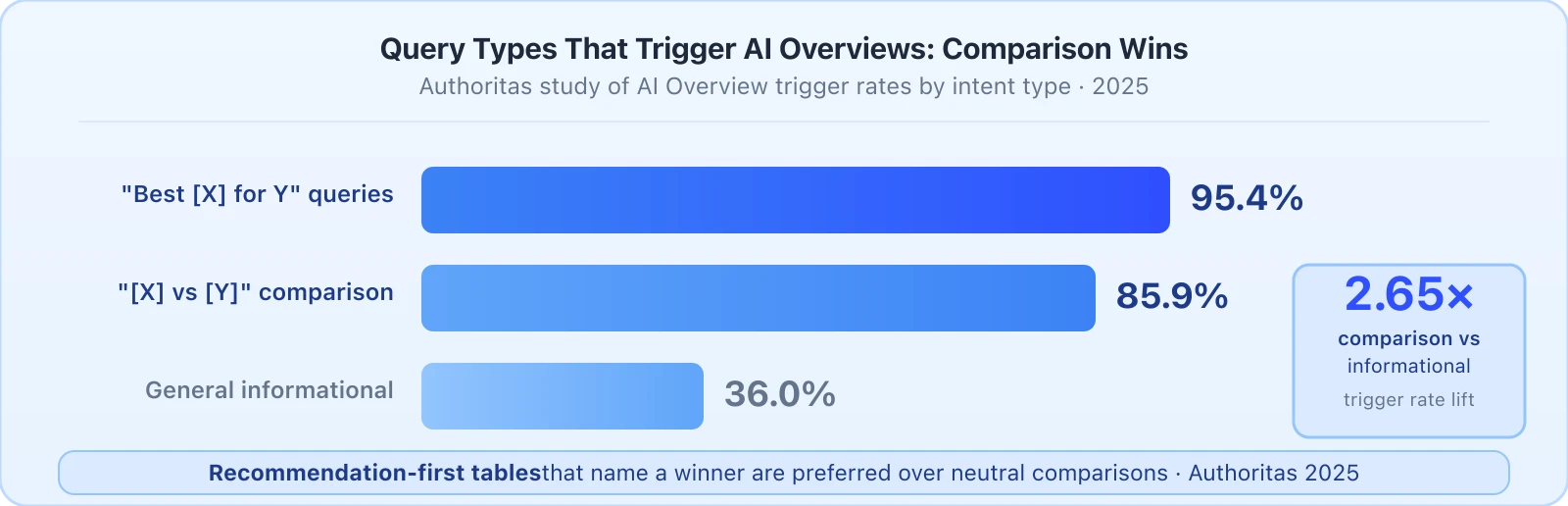
"Best vs" and "X vs Y" queries trigger Google AI Overview appearances 95.4% of the time; question-format queries 85.9%; informational queries only 36% (Onely)
Category comparison pages covering 4+ intents are in the top 4.8% of cited URLs by citation breadth: 58% of all other cited URLs are cited only once (AirOps)
Commercial queries favour listicles and comparison content at 40.86% of citation formats: the highest of any content type for commercial intent (Wix/Peec AI, cross-platform)
Comparison queries are the highest-performing AI search trigger type by a wide margin. "Best vs" and "X vs Y" queries produce AI Overview appearances 95.4% of the time, versus 85.9% for question-format queries and only 36% for informational queries. The gap is structural: AI systems are designed to synthesise comparison answers from multiple sources, and comparison pages that directly cover the contrast are the most efficient retrieval input for that task.
What is comparison table SEO for AI search and why do "best vs" queries dominate?
Comparison table SEO refers to the practice of structuring content around direct comparisons, whether "X vs Y," "best X for Y use case," or "[Option A] vs [Option B] comparison," in formats that AI systems can extract and synthesise into comparison answers. Unlike informational content designed to explain a single topic, comparison content covers multiple options simultaneously, making it naturally suitable for the multi-source retrieval pattern AI systems use when composing comparison responses.
The mechanism works at the query level: when a user asks an AI "what is the best project management tool for remote teams," the AI generates multiple sub-queries covering individual candidates and comparison angles, then retrieves sources covering those comparisons. A page that directly answers "Asana vs Monday vs ClickUp for remote teams" is a precise match for those sub-queries. An informational page about project management tools covers the topic but not the comparison: it is retrieved less efficiently for the comparison query.
Do comparison tables and "best vs" content improve AI search citation rates?
Yes: comparison queries are the highest-performing AI search trigger type by a wide margin.
"Best vs" and "X vs Y" queries trigger Google AI Overview appearances 95.4% of the time. Question-format queries produce AI Overviews at 85.9%. Informational queries produce them at only 36%. The gap is structural: AI systems are built to synthesise comparison answers from multiple sources, and comparison pages that directly cover the contrast are the most efficient retrieval input for that task.
For commercial queries specifically, listicles and comparison pages dominate citation patterns. A Wix/Peec AI study of cross-platform citation data found commercial queries favour listicles at 40.86%, the format most associated with comparison and "best of" content.
The multi-source retrieval advantage
When an AI system processes a comparison query, it generates sub-queries covering individual candidates, comparison dimensions, and use-case angles. A page that directly addresses the comparison: "Asana vs Monday for remote teams": is a precise match for multiple sub-queries simultaneously. A page covering Asana alone is a partial match for the same query. Comparison pages earn citation across a wider sub-query surface than single-topic pages.
This compounds with the AirOps finding on fan-out coverage: pages covering 26–50% of ChatGPT's fan-out sub-queries achieve 38.2% citation rates. A comparison page covering three to four options addresses multiple fan-out queries about each option, naturally improving fan-out coverage without additional pages.
Tables and format: the 25–35% structure ratio
AirOps data shows lists and tables at 25–35% of content produce the best citation outcomes. For comparison content, tables are the most efficient format: a comparison table communicates multiple data points per row in a scannable structure that AI systems extract precisely: each row is a discrete comparison unit that maps to a specific user question about one option.
Format specifics that maximise extraction: a comparison table with consistent columns (features, pricing, use case, pros/cons) and a direct recommendation row at the top of the table. The recommendation row matches the AI's task of synthesising a comparison into a direct answer.
Category comparison pages: the top 4.8% citation tier
An AirOps study found the top 4.8% of cited URLs are category-level comparison pages, covering what, who, how, and pricing simultaneously. These pages are the same evergreen, multi-intent format that earns durable citation breadth: they are cited across a broader query range than single-intent pages because they cover the full fan-out surface for a category query.
58% of cited URLs are cited only once per topic. Category comparison pages, by contrast, are cited across multiple query types for the same topic: the breadth advantage of covering multiple options simultaneously.
What the evidence doesn't prove
The 95.4% AI Overview trigger rate for comparison queries reflects query type performance, not page type performance. A weak comparison page does not inherit the trigger rate of strong comparison content. The rate tells you which query types produce AI Overviews; what gets cited from those Overviews still depends on content quality, heading structure, and traditional search position.
The 25–35% table/list ratio is observational from current page data. It reflects what is being cited now under current AI retrieval logic. As AI platforms update their extraction systems, the optimal format may shift.
How to build comparison pages that maximise AI search citations
7 independent sources back this finding: high confidence across google-aio, chatgpt, perplexity, gemini. Act on this now: it's one of the better-evidenced tactics in the database. This scales with your publishing output. Every new piece of content is an opportunity to apply it: start with your highest-traffic pages and work backwards through your archive.
Implementation
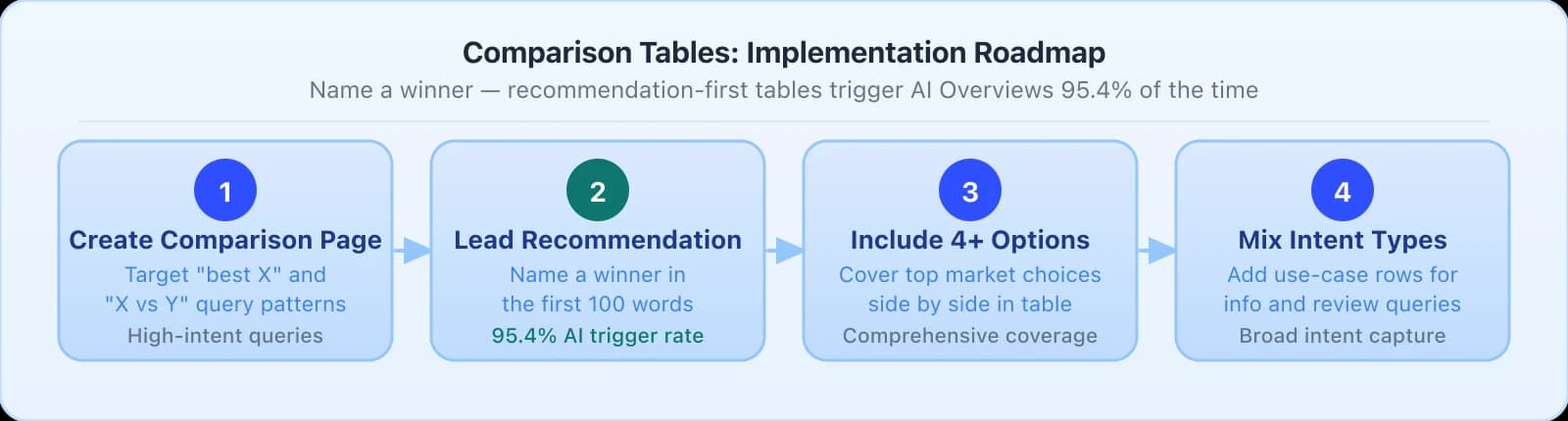
Create a dedicated comparison page for your primary category with a structured table covering features, pricing, best-for use case, and pros/cons: comparison queries trigger AI Overview appearances 95.4% of the time versus 36% for informational queries.
Put a direct recommendation at the top of the comparison table, not at the bottom after the data: AirOps found 44.2% of AI citations come from the first 30% of page content. A comparison that makes readers scroll to find the recommendation loses AI citation potential on the most important section.
Cover at least 4 options in each comparison: AirOps found category comparison pages covering 4+ intents are in the top 4.8% of cited URLs by citation breadth. Each additional option adds fan-out sub-query coverage for queries about that specific option.
Combine commercial and informational intent in the same comparison page: commercial queries favour listicles and comparison content at 40.86% of citation formats (Wix/Peec AI). Comparison pages covering both "X vs Y features" and "X vs Y pricing for [use case]" earn citations across both intent types.
Frequently asked questions
Does structuring comparisons as semantic HTML tables help you get cited in AI search results?
Yes: high confidence across 7 sources (score: 13.2/35). No contradicting evidence found.
Does structuring comparisons as semantic HTML tables work for ChatGPT, Perplexity, and Google AI Overviews?
The research covers google-aio, chatgpt, perplexity, gemini. No platform-official statement exists yet: the evidence comes from academic research and independent practitioner experiments. Results may vary by platform as AI systems evolve: verify against current documentation before acting.
How was the evidence collected?
The 7 sources use controlled experiments and observational studies. 2 sources are academic or peer-reviewed. All sources are listed with direct links in the Sources section below.
Should I prioritise Structure comparisons as semantic HTML tables over other GEO tactics?
Given the high confidence rating and strong independent corroboration, yes: this is one of the better-evidenced tactics in the database. This scales with your publishing output. Every new piece of content is an opportunity to apply it: start with your highest-traffic pages and work backwards through your archive.
How this score is calculated
Each source is weighted by tier, independence, and how recent it is. Open the breakdown to see every source and how the score has changed over time.
Sources
IndependentGrowth Memo·
Content Types & Formats That Earn Mentions in LLMs
AcademicOnely·
Claude vs ChatGPT Citation Analysis
IndependentProfound·
BrightEdge Research: AI Citation Patterns in ChatGPT and Google AI Overviews
IndependentBrightEdge·
AIO Impact on Google CTR: 2026 Update
IndustrySeer Interactive·
Last reviewed: Evidence score: 13.2 / 357 supporting · 0 contradicting