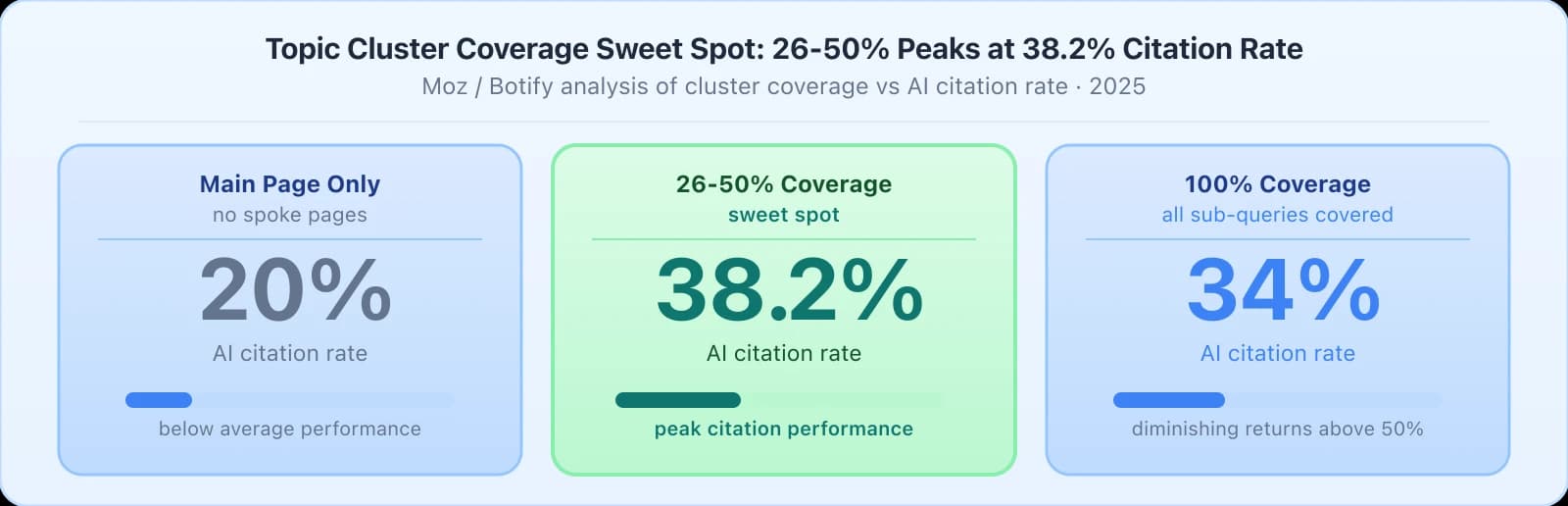
Yes — topic clusters improve GEO coverage across AI fan-out queries. Hub-and-spoke gives AI clear topical signals and boosts adjacent query citation surface reach.
12 sources reviewed · Confidence: Low (4.9/35) · Covers google-aio, chatgpt, perplexity, gemini
Key findings
Document structure drives 17.3% average citation improvement across AI engines: macro-structure (headings, page organisation) accounts for 44.9% of that gain (arXiv, 6 AI engines)
32.9% of AI-cited pages discoverable only through fan-out sub-queries; pages covering 26–50% of fan-out queries cited at 38.2% vs 34% for 100%-coverage pages (AirOps)
Domain authority shows no positive correlation with AI citation probability: topical precision predicts citations; pages ranking for main + fan-out queries achieve 51% AIO rate (AirOps, 353,799 pages)
Topic clusters were designed for Google's crawl and link signals. For AI search, they solve a different problem: fan-out query coverage. ChatGPT generates 25+ sub-queries from each user prompt, and a hub-and-spoke content structure naturally addresses the full range of adjacent queries AI systems generate from a category-level question. Pages ranking for the main query plus at least one fan-out query achieve 51% AI Overview citation rates versus 20% for main-query-only rankers ([AirOps](https://www.airops.com/)).
What is topic cluster architecture for AI search?
A topic cluster is a content architecture where a central hub page covers a broad topic at depth, with linked spoke pages each addressing a specific subtopic or angle. For AI search, the hub-and-spoke structure serves two purposes. First, it establishes topical authority: consistent signals across multiple related pages reinforcing your brand's expertise on a specific topic to AI retrieval systems. Second, it creates fan-out query surface: each spoke page covers one of the sub-queries AI systems generate when processing a hub-level question.
The mechanism is not internal linking for its own sake. A Growth Memo analysis found document structure drives 17.3% average citation improvement independent of content quality, with macro-structure (heading architecture, page organisation) accounting for 44.9% of that gain. Topic clusters create that structure at the site level: pages referencing each other and covering the topic from multiple angles signal to AI retrieval systems that this domain has genuine coverage of the topic, not just one optimised page.
Does topic cluster architecture improve AI search citations?
Yes: but the path to citation improvement runs through fan-out query coverage, not traditional SEO authority signals.
The finding that most challenges standard topic cluster strategy: domain authority shows no positive correlation with AI citation probability and is slightly inversely correlated (AirOps, 353,799 pages, 16,851 queries). Domain authority is what topic clusters have traditionally been built to increase. For AI search, it doesn't predict citation outcomes. Topical precision does.
Fan-out coverage is the mechanism
A Profound/Tinuiti analysis found that 32.9% of AI-cited pages are discovered only through fan-out sub-queries: invisible to the original user prompt and to traditional keyword monitoring. Hub-and-spoke architecture creates natural fan-out coverage: the hub page handles the primary query, spoke pages handle the sub-queries generated from it.
Pages ranking for the main query plus at least one fan-out query achieve a 51% AI Overview citation rate versus 20% for main-query-only rankers. Each spoke page is potential coverage for a fan-out query. The hub page creates the topical authority signal that helps spoke pages rank for those adjacent queries.
Structure drives 17.3% citation improvement
An arXiv study on structural feature engineering found document structure alone drives an average 17.3% citation rate improvement across six AI engines, independent of content quality changes. Macro-level structure: heading architecture, schema, page organisation: accounts for 44.9% of that gain.
At the site level, topic clusters create consistent heading hierarchies and internal linking patterns that reinforce topic-entity relationships. An AI retrieval system encountering five related pages with consistent topic signals reads that as topical authority. A single well-optimised page on the same topic sends a weaker signal.
Google AI Mode vs AI Overviews: different citation logic
Google AI Mode cites only 12% of top-10 organic results: versus 38% for AI Overviews. Despite 86% semantic answer overlap between the two platforms, they share only 13.7% of cited URLs. Sites outside the top 10 in traditional search can earn AI Mode citations through fan-out query coverage on adjacent subtopics.
This matters for topic cluster strategy: spoke pages ranking outside the top 10 organically can still appear in AI Mode citations if they cover a specific fan-out sub-query with high relevance. The spoke page's job is fan-out coverage, not main-query ranking.
Focused coverage outperforms exhaustive coverage
The counterintuitive finding from AirOps: pages covering 26–50% of ChatGPT's fan-out sub-queries are cited at 38.2%, while pages covering 100% are cited at 34%. Comprehensive coverage doesn't maximise citations. Focused, precise coverage of the right subtopics does.
For topic cluster strategy, this means spoke pages should cover specific subtopic questions with depth, not attempt to be comprehensive on every adjacent angle. One spoke page per sub-query cluster, not one per topic.
Winning a topic cluster means owning the category across all five buyer-intent types, not just the definitional one
A Semrush analysis of 50,000 brands across 1,094 categories tracked ChatGPT visibility using five representative prompt types per category: definition, comparison, alternatives, use case, and buying inquiry. It defined "category ownership" as appearing in at least 4 of the 5 prompt types, with a 5-percentage-point lead over the next brand.
Only 15.2% of categories had a clear owner as of mid-2026. 31.2% had an emerging leader without the required lead. 53.7% were fully open, with no brand appearing consistently at all.
The stricter bar matters specifically for hub-and-spoke strategy: a cluster built entirely around definitional, informational sub-queries only covers one of the five intent types a category owner needs. A spoke page answering "alternatives to X" or "how much does X cost" closes a different gap than a spoke page defining X, and clearing the 4-of-5 threshold requires both.
Traditional SEO authority barely predicts which brand wins the category. Branded search volume predicted the category owner in only 55.7% of brand pairs, organic traffic in 48.4%, and Authority Score in 52.5%: each only marginally better than chance. This sharpens the domain-authority finding earlier in this dossier. Domain authority does not just fail to predict individual-page citation; it also fails to predict which brand ends up owning the category overall.
(This is a single industry study, not yet part of this tactic's scored evidence base below. Treat the category-ownership framework and the 15.2%/31.2%/53.7% split as a useful lens for judging cluster completeness, not as confirmed causal mechanics on the same footing as the arXiv and AirOps findings above, consistent with this tactic's own Low confidence label.)
What the evidence doesn't prove
The citation benefits described are based on observational data from pages already performing well. Correlation between topic cluster coverage and AI citations cannot confirm that building topic clusters caused the citation increase versus pre-existing topical authority doing so.
The 17.3% structural improvement is from an arXiv study that tested document structure in isolation, not a live test of topic cluster architecture across a real site. Real-world implementation results will vary.
How to build hub-and-spoke topic clusters for GEO
12 independent sources back this finding: low confidence across google-aio, chatgpt, perplexity, gemini. Treat this as an early signal. Monitor as more research emerges before committing significant resources. This scales with your publishing output. Every new piece of content is an opportunity to apply it: start with your highest-traffic pages and work backwards through your archive.
Implementation
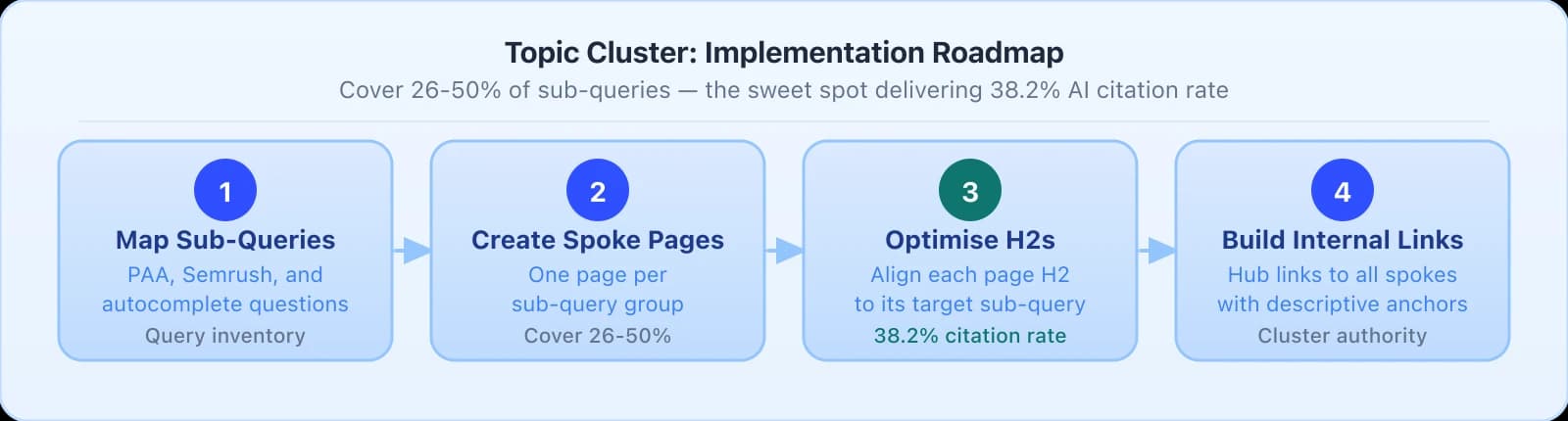
Map the sub-queries AI systems generate from your hub page's primary topic: prompt ChatGPT with "generate 25 sub-queries an AI would generate when answering about [hub topic]". Each unique sub-query cluster is a spoke page opportunity. Pages ranking for the main query plus one fan-out query achieve 51% AI Overview citation rate versus 20% for main-query-only rankers (AirOps).
Create or audit spoke pages so each covers exactly one sub-query cluster with depth: document structure drives 17.3% average citation improvement (arXiv). One precise spoke page per sub-query outperforms one comprehensive page covering all sub-queries.
Write each spoke page's H1 and H2 headings to match the exact sub-query language: an AirOps study found 50%+ word overlap between page title and AI query achieves a 2.2× citation lift. Spoke headings should match the sub-query they target, not use branded or creative phrasing.
Add internal links from hub to each spoke and spoke back to hub using descriptive anchor text: use the sub-query language as the anchor text. Internal links help AI crawlers identify the cluster structure and reinforce each spoke page's sub-query relevance signal.
⚠ Evidence is low: treat these steps as experimental, not established practice. Run a small test before broad rollout.
Frequently asked questions
Does building topic clusters with hub-and-spoke architecture help you get cited in AI search results?
Yes: low confidence across 12 sources (score: 4.9/35). No contradicting evidence found.
Does building topic clusters with hub-and-spoke architecture work for ChatGPT, Perplexity, and Google AI Overviews?
The research covers google-aio, chatgpt, perplexity, gemini. No platform-official statement exists yet: the evidence comes from academic research and independent practitioner experiments. Results may vary by platform as AI systems evolve: verify against current documentation before acting.
How was the evidence collected?
The 12 sources use observational studies and controlled experiments. 4 sources are academic or peer-reviewed. All sources are listed with direct links in the Sources section below.
Should I prioritise Build topic clusters with hub-and-spoke architecture over other GEO tactics?
With a low confidence rating, this should be treated as secondary to higher-confidence tactics. This scales with your publishing output. Every new piece of content is an opportunity to apply it: start with your highest-traffic pages and work backwards through your archive.
How this score is calculated
Each source is weighted by tier, independence, and how recent it is. Open the breakdown to see every source and how the score has changed over time.
Sources
AcademicGrowth Memo·
Bing Rankings Drive ChatGPT Visibility More Than Google — New Study
IndependentSearch Engine Land·
AcademicMoz·
Revive old content to win in AI search
IndustryMarTech·
Google AI Mode Citation Research
IndependentSE Ranking·
AI Overview Fan-out Rankings Boost Citation Odds by 161%
IndependentSurfer SEO (via Search Engine Land)·
IndustryAirOps·
Last reviewed: Evidence score: 4.9 / 3512 supporting · 0 contradicting
Related analysis