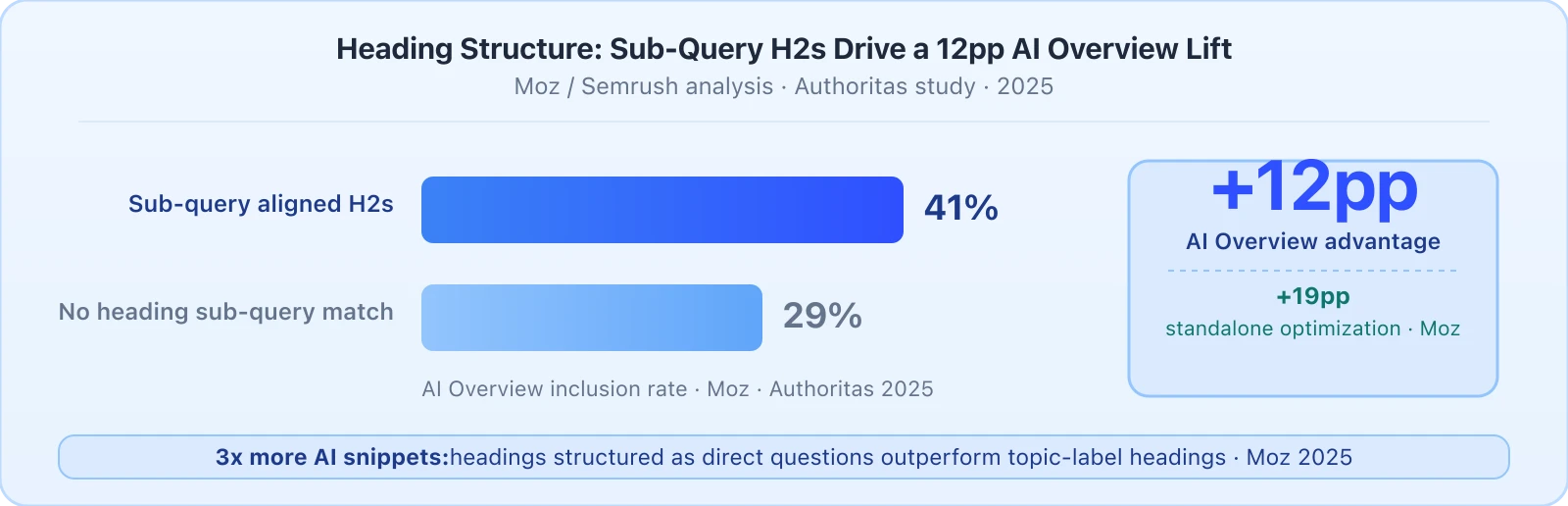
Yes — heading SEO improves AI search section extraction. Logical H2/H3 hierarchies matching user query patterns help AI systems identify and cite the right sections.
6 sources reviewed · Confidence: High (12.0/35) · Covers all
Key findings
Heading-to-query cosine similarity ≥0.90 achieves 41% ChatGPT citation rate vs 29% for <0.50, a 12 percentage point gap independent of domain authority (AirOps, 16,851 queries, 353,799 pages)
Query-matched headings add 19 percentage points to citation rate even for pages already ranking highly in traditional search: heading structure is an independent AI citation signal (AirOps)
Headings account for 44.9% of the 17.3% average citation improvement from structural changes: the single largest structural contributor (arXiv, 6 AI engines)
Heading-to-query similarity is the strongest on-page content signal for AI citations: stronger than word count, domain authority, or topical breadth. An AirOps analysis of 16,851 queries across 353,799 pages found pages with heading-to-query cosine similarity above 0.90 achieve a 41% ChatGPT citation rate, versus 29% for similarity below 0.50. Query-matched headings add 19 percentage points even among pages that already rank highly. The gap isn't from better content: it's from headings that match the sub-query AI systems generate.
What is heading structure for AI search and how does it affect citations?
Heading structure for AI search refers to writing H2 and H3 headings as direct answers to the specific sub-queries AI systems generate when processing a user prompt: rather than as topic labels or keyword-rich phrases. The distinction: "What is knowledge graph SEO?" (question-format, sub-query matched) versus "Knowledge Graph SEO" (topic label). The first format matches the AI sub-query; the second matches a traditional keyword. For AI retrieval, the first is reliably extracted; the second may or may not be.
Microsoft confirmed the mechanism: descriptive headings are "signals that help AI know where a complete idea starts and ends": they segment the page into discrete answer units. When an AI system scanning a document for the answer to "how do I fix Core Web Vitals" encounters the heading "How to fix Core Web Vitals," it identifies the extraction unit immediately. A heading reading "Performance Optimisation" requires additional reading to confirm relevance: and at scale, that extra step reduces extraction probability.
Does clear heading structure improve AI search citation rates?
Yes: heading-to-query similarity is the strongest on-page content signal for AI citations in the data.
An AirOps analysis of 16,851 queries across 353,799 pages found pages with heading-to-query cosine similarity above 0.90 achieve a 41% ChatGPT citation rate, versus 29% for similarity below 0.50. That 12 percentage point gap holds even after controlling for domain authority and traditional search rank.
Crucially, the gap persists for pages already ranking highly in traditional search: query-matched headings add 19 percentage points to citation rate even among pages that already earn organic traffic. Heading structure is an independent AI citation signal, not a proxy for content quality.
Why heading-query match predicts citations
Microsoft officially confirmed the mechanism: descriptive headings are "signals that help AI know where a complete idea starts and ends." When an AI system generating an answer processes a user prompt into sub-queries, it scans candidate documents for sections where the heading matches the sub-query. A heading that precisely matches "how to fix slow LCP" is extracted immediately. A heading reading "Performance Optimisation" requires additional processing to confirm relevance: which reduces extraction probability at scale.
The operational distinction: traditional heading SEO writes headings as topic labels or keyword-rich phrases. AI-optimised headings are written as direct answers to specific sub-queries AI systems generate: the same format as a question the reader would type into a search box.
Optimal heading hierarchy
An arXiv analysis found optimal heading structure for AI citation is 3–5 heading levels (H1 through H4), with each heading describing a self-contained answer unit rather than a topic category. Headings account for 44.9% of the 17.3% average citation improvement from structural changes: the single largest structural contributor.
Lists and tables at 25–35% of content complement heading structure by creating additional extractable units. A heading followed by a bulleted list of 3–5 items is more consistently extracted than the same information in paragraph form, because the structure makes the start and end of the answer unit explicit.
The fan-out query implication
AI systems generate 25+ sub-queries from each user prompt. Each sub-query is effectively a heading test: "does this page have a heading that matches this sub-query?" Pages with question-format headings covering the expected range of sub-queries for their topic rank across more sub-queries: increasing the probability of citation for any query in that topic cluster.
A hub-and-spoke content structure with query-matched headings on each spoke page creates the broadest fan-out coverage: the hub page handles the primary query, each spoke page's headings handle sub-queries generated from the hub topic.
What the evidence doesn't prove
The AirOps cosine similarity finding is a correlation from a large dataset: it cannot separate whether heading-query alignment caused citations or whether pages with strong heading-query alignment are simply better-optimised overall. Well-structured pages with good headings also tend to have better content, faster load times, and stronger entity signals.
The 41%/29% split is from a single platform (ChatGPT). Heading sensitivity may differ across Perplexity, Google AI Overviews, and Copilot. Validate heading changes against multi-platform citation tracking before treating 41% as a universal benchmark.
How to write headings that improve AI search citation rates
2 platform-official statements plus 4 corroborating sources back this finding: high confidence across all. Act on this now: it's one of the better-evidenced tactics in the database. This scales with your publishing output. Every new piece of content is an opportunity to apply it: start with your highest-traffic pages and work backwards through your archive. Note: 1 source contradicts this: review the contradicting evidence section before acting.
Implementation
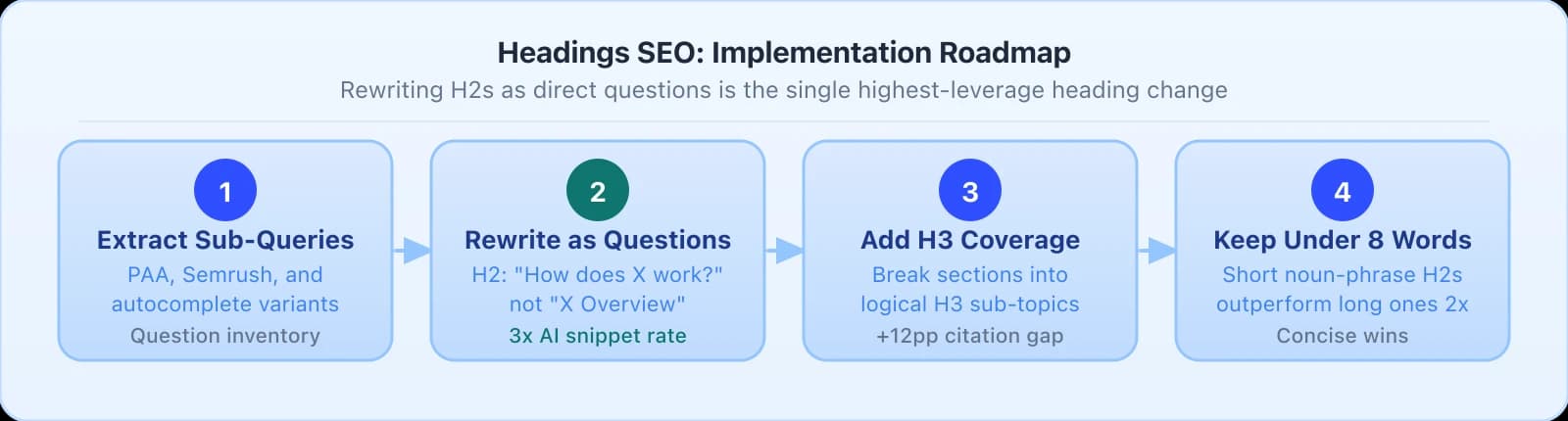
Rewrite H2 headings as direct questions matching specific AI sub-queries: use "What is", "How does", "Why does", or "How to" followed by the specific entity. Pages with heading-to-query cosine similarity ≥0.90 achieve 41% ChatGPT citation rate versus 29% for <0.50 (AirOps, 353,799 pages).
Audit your top pages by generating sub-queries: prompt ChatGPT with "generate 20 sub-queries an AI would generate when answering about [your topic]", then count how many of your current headings match. Each unmatched sub-query is a citation gap.
Add H3 headings under each H2 to cover follow-up sub-queries: AirOps found pages covering 26–50% of fan-out sub-queries are cited at 38.2%. H3 headings increase sub-query surface area without requiring additional pages.
Keep H2 headings under 8 words where possible: shorter headings match AI sub-queries more precisely. Headings account for 44.9% of the 17.3% average citation improvement from structural changes (arXiv, 6 AI engines).
Does any research contradict this?
1 source contradicts this tactic. Consider these findings alongside the supporting evidence before acting.
More section headings are associated with 29% lower odds of ranking in top 3, suggesting over-structuring content is counterproductive.
“A one-standard-deviation increase in heading count after adjusting for unusually large values was associated with 29% lower top-3 odds.”
Independent Growth Memo · Sep 2026 · contradicts
Frequently asked questions
Does using clear H2/H3 heading structure help you get cited in AI search results?
Yes: high confidence across 6 sources (score: 12.0/35). 2 are platform-official: the strongest possible signal. 1 source contradicts this: see the contradicting evidence section before acting.
Does using clear H2/H3 heading structure work for ChatGPT, Perplexity, and Google AI Overviews?
The research covers all. Platform-official guidance exists for this tactic: the strongest possible confirmation. Results may vary by platform as AI systems evolve: verify against current documentation before acting.
How was the evidence collected?
The 6 sources use official platform documentation and controlled experiments. 2 sources are academic or peer-reviewed. All sources are listed with direct links in the Sources section below.
Should I prioritise Use clear H2/H3 heading structure over other GEO tactics?
Given the high confidence rating and platform-official backing, yes: this is one of the better-evidenced tactics in the database. This scales with your publishing output. Every new piece of content is an opportunity to apply it: start with your highest-traffic pages and work backwards through your archive.
How this score is calculated
Each source is weighted by tier, independence, and how recent it is. Open the breakdown to see every source and how the score has changed over time.
Sources
Optimizing Your Content for Inclusion in AI Search Answers
Platform officialMicrosoft·
Platform officialOpenAI·
ChatGPT's Own Index Served Sites Without Deals The Same Way
IndependentResoneo·
IndustryAirOps·
IndependentGrowth Memo· September 2026· contradicts
Last reviewed: Evidence score: 12.0 / 356 supporting · 1 contradicting
Related analysis