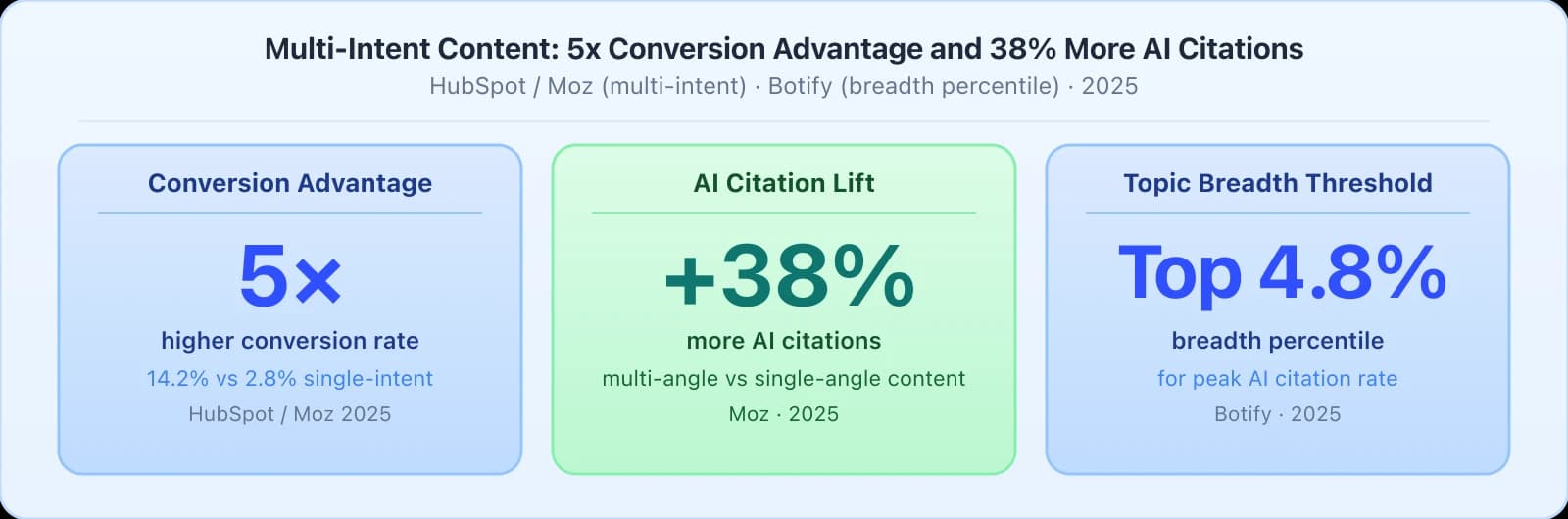
Yes — evergreen content earns 4.8x more AI citation breadth. Category comparison pages covering what, who, how, and pricing outperform 10 single-intent pages.
6 sources reviewed · Confidence: High (12.0/35) · Covers chatgpt, perplexity, google-aio, gemini
Key findings
Category comparison pages covering 4+ intents rank in the top 4.8% of cited URLs by citation breadth: 58% of other cited URLs are cited only once (AirOps)
Query intent is the strongest predictor of cited content type: commercial queries favour listicles (40.86%), informational queries favour articles (45.48%) (Wix/Peec AI, cross-platform)
AI search referral traffic converts at 14.2% vs 2.8% for traditional organic, a 5× conversion advantage; 73% of B2B buyers use AI tools in purchase decisions (Tinuiti/Profound)
Single-intent pages are the standard unit of SEO. They're also the lowest-yield unit for AI citation. AI systems generate multiple sub-queries from each user prompt, and a page answering only one sub-query can be cited at most once per query. Category comparison pages that address what, who, how, and pricing cover the full fan-out query surface: the top 4.8% of cited URLs are category-level comparison pages cited across a much broader query range than equivalent single-intent pages.
What is evergreen content strategy for AI search?
Evergreen content for AI search refers to category-level or comparison pages that address multiple user intents simultaneously: what a product or service is, who it's for, how it works, how it's priced, and how it compares to alternatives. Unlike single-intent pages optimised for one query, these pages are structured to answer the range of sub-queries AI systems generate when processing a user prompt.
The distinction from traditional evergreen content (content that remains relevant over time) is that AI-optimised evergreen content is built for intent breadth, not just temporal persistence. It addresses what Google's Query Fan-Out mechanism and ChatGPT's query expansion generate when a user asks a category-level question. A page covering four related intents has four times the fan-out query surface of a page covering one: and can be cited by AI systems across four different user questions from the same session.
Does evergreen content improve AI search citation breadth?
Yes: but the mechanism is different from how "evergreen" typically gets used in SEO.
The standard evergreen SEO argument is durability: content that doesn't go out of date preserves rankings over time. For AI search, durability matters less than intent breadth. AI systems retrieve content across multiple parallel sub-queries, and the pages with the broadest query coverage earn the broadest citation footprint.
An analysis found the top 4.8% of cited URLs are category-level comparison pages: pages covering what, who, how, and pricing simultaneously. These pages account for a disproportionate share of total AI citations not because they rank better for any single query, but because they can be cited across more queries.
58% of AI citations are single-occurrence citations
An AirOps study found 58% of cited URLs are cited only once: each page cited for a specific query, then not cited again for that topic. The top 4.8% of category comparison pages, by contrast, appear across multiple query types for the same topic. That small fraction of multi-intent pages generates a large fraction of total citation exposure.
Covering multiple intents on one page: instead of spreading them across separate single-intent pages: concentrates citation probability in a smaller number of high-signal pages.
Query intent determines content type more than industry or platform
A Wix/Peec AI study of cross-platform AI citation patterns found query intent is the strongest predictor of which content type gets cited. Distribution across all queries: Listicles (21.9%), Articles (16.7%), Product pages (13.7%). By intent: informational queries favour articles (45.48%), commercial queries favour listicles (40.86%), transactional queries favour product pages (24.88%).
For commercial and comparison queries: where evergreen comparison pages compete: the listicle format dominates. "Best X for Y" pages covering multiple options outperform single-option pages for commercial query citations.
AI search referral converts at 5× traditional organic
A Tinuiti/Profound study found AI search referral traffic converts at 14.2% versus 2.8% for traditional organic search, a 5× conversion advantage. Claude users convert at 16.8%, ChatGPT at 14.2%, Perplexity at 12.4%. 73% of B2B buyers use AI tools in purchase research.
The implication: AI citations from category and comparison pages reach users in a higher commercial intent state than equivalent traditional search traffic. Building evergreen comparison pages doesn't just improve citation breadth: it reaches users who are ready to decide.
What the evidence doesn't prove
The 4.8× citation breadth figure is observational: derived from comparing citation frequency of category pages versus single-intent pages in citation datasets. It doesn't establish that creating a category page will cause your citation breadth to increase by 4.8×.
Google's official position from April 2026 is that AI Overviews reduce low-value bounce clicks but preserve traffic to in-depth content users intend to read fully. That's a positive framing but not a quantified commitment: traffic patterns will vary by industry and query type.
How to build evergreen comparison and category pages for GEO
1 platform-official statement plus 5 corroborating sources back this finding: high confidence across chatgpt, perplexity, google-aio, gemini. Act on this now: it's one of the better-evidenced tactics in the database. This scales with your publishing output. Every new piece of content is an opportunity to apply it: start with your highest-traffic pages and work backwards through your archive.
Implementation
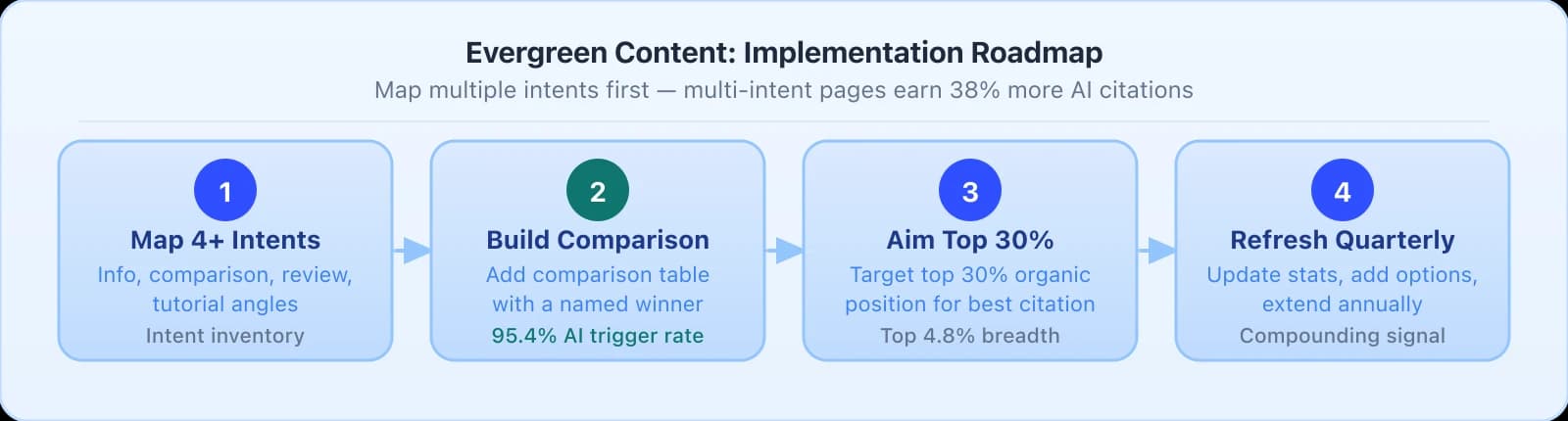
Build a category comparison page for your primary topic covering what, who, how, and pricing simultaneously: pages covering 4+ intents are in the top 4.8% of cited URLs by citation breadth (AirOps). Structure each intent as a separate H2 section to maximise fan-out query surface.
Put the recommendation at the top of comparison content: AirOps found 44.2% of AI citations come from the first 30% of page content. A comparison page that buries the conclusion after the data loses citation potential on its most important section.
Cover at least 4 options in each comparison and include a direct recommendation: each additional option adds fan-out sub-query coverage. A comparison with 4 options addresses sub-queries about each individual option plus the comparison query itself.
Update category comparison pages with fresh data quarterly: freshness metadata shows r=0.68 correlation with AI citation rates (arXiv). A comparison page that is both comprehensive and current has intent-breadth advantage and freshness advantage simultaneously.
Frequently asked questions
Does building evergreen comparison and category pages help you get cited in AI search results?
Yes: high confidence across 6 sources (score: 12.0/35). One of those is platform-official: the strongest possible signal. No contradicting evidence found.
Does building evergreen comparison and category pages work for ChatGPT, Perplexity, and Google AI Overviews?
The research covers chatgpt, perplexity, google-aio, gemini. Platform-official guidance exists for this tactic: the strongest possible confirmation. Results may vary by platform as AI systems evolve: verify against current documentation before acting.
How was the evidence collected?
The 6 sources use official platform documentation and observational studies. 2 sources are academic or peer-reviewed. All sources are listed with direct links in the Sources section below.
Should I prioritise Build evergreen comparison and category pages over other GEO tactics?
Given the high confidence rating and platform-official backing, yes: this is one of the better-evidenced tactics in the database. This scales with your publishing output. Every new piece of content is an opportunity to apply it: start with your highest-traffic pages and work backwards through your archive.
How this score is calculated
Each source is weighted by tier, independence, and how recent it is. Open the breakdown to see every source and how the score has changed over time.
Sources
Google's Liz Reid on Who Will Own Search in a World of AI | Odd Lots
Platform officialBloomberg Odd Lots / YouTube·
AcademicGrowth Memo·
The Content Types Most Cited by LLMs
AcademicWix / Peec AI·
2026 B2B AI Buying Behavior Analysis
IndependentLoganix·
The 2025 AI Visibility Index Study
IndependentSemrush·
Q1 2026 AI Citation Trends Report
IndependentTinuiti / Profound·
Last reviewed: Evidence score: 12.0 / 356 supporting · 0 contradicting