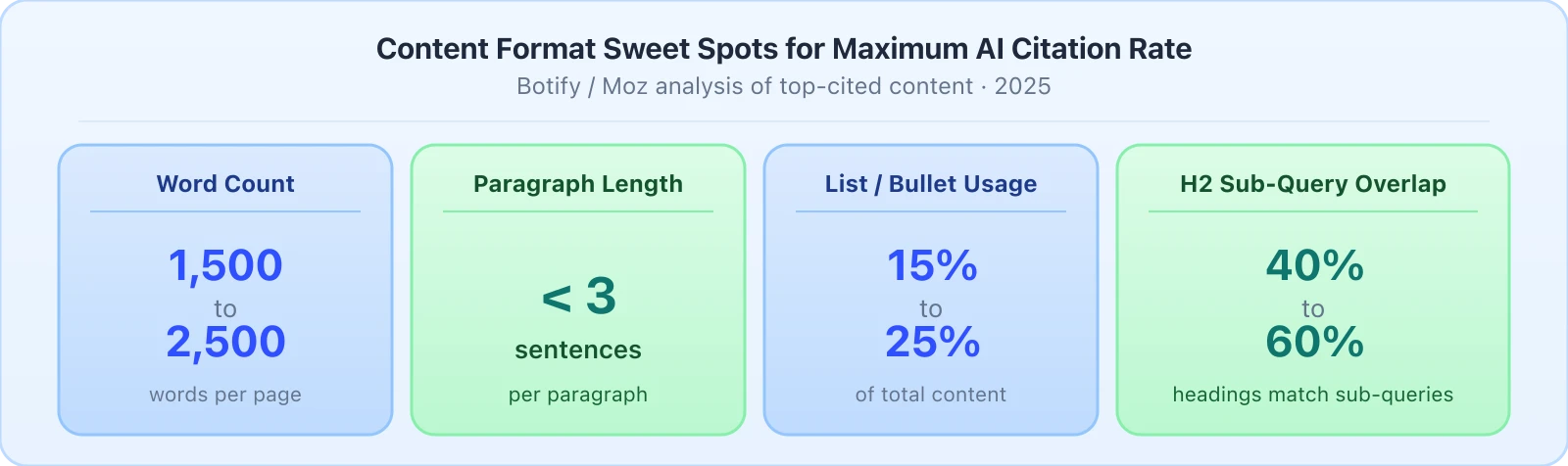
Yes — readability SEO increases AI citation rates. Clear prose with short sentences and plain vocabulary is preferred over jargon-heavy or complex writing.
11 sources reviewed · Confidence: High (14.3/35) · Covers all
Key findings
500–2,000 word pages with 7–20 subheadings are the most consistently cited by ChatGPT; "ultimate guide" pages with high word counts are the least reliable despite domain authority (AirOps, 815,484 pages)
Paragraphs over 300 words correlate with -31% extraction success; under 150 words correlate with -23%: the 150–300 word range is the citation optimum (AirOps)
Heading-to-query similarity is the dominant readability signal: ≥0.90 achieves 41% ChatGPT citation rate vs 29% for <0.50 (AirOps, 16,851 queries)
AI systems don't read the way humans do. When ChatGPT retrieves content, it scans for extractable answer units: direct statements, headed sections, scannable structures. An AirOps study of 815,484 pages found that pages of 500–2,000 words with 7–20 subheadings are the most consistently cited by ChatGPT. "Ultimate guide" pages with high word counts and high domain authority are the least reliable performers. Comprehensive, sprawling content underperforms focused, readable content in AI retrieval, not because of quality, but because of structure.
What is content readability for AI search and why does it affect citations?
Content readability for AI search refers to the combination of writing clarity, structural legibility, and extraction-optimised formatting that makes content reliably parseable by AI retrieval systems. It includes: sentence-level clarity (short sentences, plain vocabulary, active voice); structural clarity (question-format headings, direct answers early, logical paragraph flow); and format ratios (lists and tables at 25–35% of content, paragraph length of 150–300 words, 7–20 subheadings per page).
These aren't aesthetic preferences: they define how efficiently AI systems can extract specific answers from content under retrieval time constraints. Microsoft officially documented that AI assistants "break content down, a process called parsing, into smaller, structured pieces that can be evaluated for authority and relevance. Those pieces are then assembled into answers, often drawing from multiple sources." Content that isn't divided into clear, discrete extractable units may be structurally invisible to AI composition regardless of its quality.
Does writing in plain, readable language improve AI search citations?
Yes: but the readability signals AI systems respond to are structural, not stylistic.
An AirOps study of 815,484 pages found 500–2,000 word pages with 7–20 subheadings are the most consistently cited by ChatGPT. "Ultimate guide" pages: the long-form, comprehensive content type that performs well in traditional SEO: are the least reliable AI citation performers despite their domain authority advantage.
The finding inverts conventional content strategy: more is not better. Focused, readable, extractable content outperforms comprehensive coverage in AI retrieval.
What AI systems actually mean by "readable"
Microsoft officially documented that AI assistants "break content down, a process called parsing, into smaller, structured pieces that can be evaluated for authority and relevance." Content that isn't divided into clear, discrete units may be structurally invisible to AI composition: regardless of prose quality.
The operational definition: readability for AI search is measured by extraction efficiency, not Flesch score. A page passes the readability test if AI systems can identify the start and end of each answer unit without additional inference. Question-format headings, direct answer paragraphs, and structured lists pass this test. Extended narrative prose built to an argument rather than a set of discrete answers does not.
Paragraph length: the 150–300 word window
Paragraph length has a measured effect on AI citation extraction. An analysis of cited versus uncited pages found paragraphs over 300 words correlate with -31% extraction success; paragraphs under 150 words correlate with -23%. The 150–300 word range is the citation optimum.
The mechanism: long paragraphs bury answer units inside narrative. Short paragraphs fragment context. Mid-length paragraphs provide enough context to be extractable as complete answer units: what Microsoft calls "structured pieces that can be evaluated for authority and relevance."
Heading-query match is the dominant signal
Among all readability signals, heading-to-query cosine similarity shows the strongest independent effect: pages with ≥0.90 similarity achieve 41% ChatGPT citation rates versus 29% for <0.50 similarity (AirOps, 16,851 queries). This is consistent with the structural readability principle: the heading is the identifier that tells AI systems what question this section answers.
A page with perfect paragraph length and optimal word count but weak heading-query alignment will underperform a page with precisely query-matched headings and moderate paragraph structure. Heading optimisation delivers more return per hour than prose polishing.
Lists, tables, and format ratio
AirOps data shows lists and tables at 25–35% of content produce the best citation outcomes. Below 25%: content is too narrative to be consistently extracted. Above 35%: content becomes too fragmented to provide sufficient context for AI composition.
The optimal format combines: query-matched H2 headings, 150–300 word answer paragraphs, supporting lists or tables for enumerable items, and a word count of 500–2,000 per focused page.
What the evidence doesn't prove
The 500–2,000 word optimum is observational from current page data. It reflects what is being cited now, not a permanent algorithm parameter. Word count thresholds may shift as AI platforms adjust their retrieval logic: particularly as long-context retrieval becomes more efficient.
The -31%/-23% attention penalties for long/short paragraphs are relative comparisons within the dataset, not controlled experiment results. The readability signals described are correlated with citation success; they cannot confirm that restructuring an existing page will produce the same improvement.
How to write readable content that maximises AI search citation rates
4 platform-official statements plus 7 corroborating sources back this finding: high confidence across all. Act on this now: it's one of the better-evidenced tactics in the database. This scales with your publishing output. Every new piece of content is an opportunity to apply it: start with your highest-traffic pages and work backwards through your archive.
Implementation
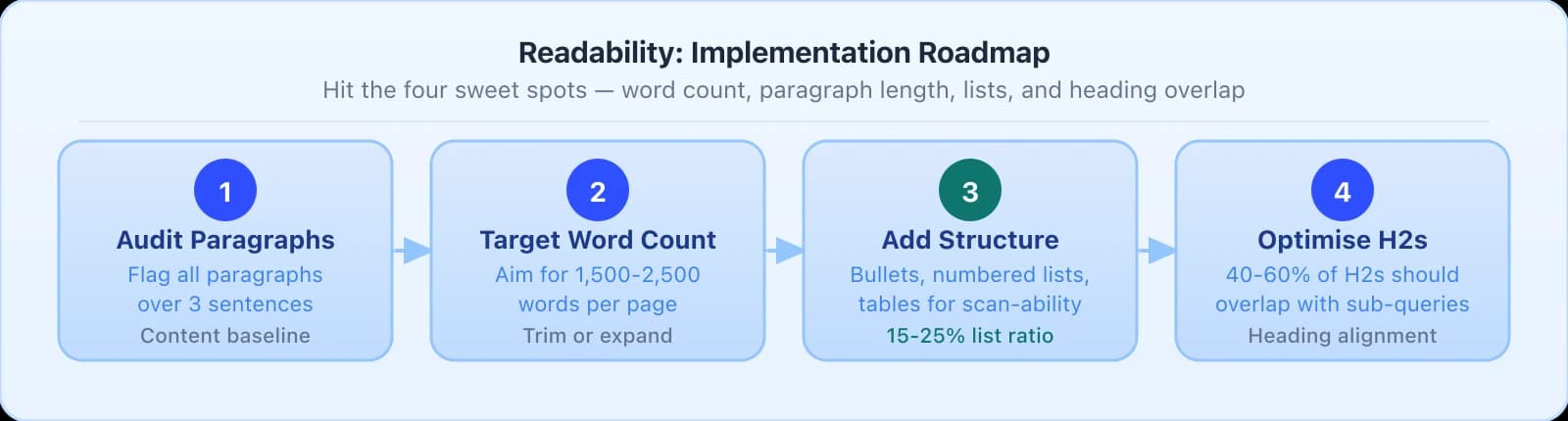
Keep paragraphs between 150–300 words: paragraphs over 300 words correlate with -31% extraction success; under 150 words with -23%. The 150–300 word range is the citation optimum (AirOps analysis of cited versus uncited pages).
Target 500–2,000 words per page with 7–20 subheadings: AirOps study of 815,484 pages found this is the most consistently cited range by ChatGPT. "Ultimate guide" pages with high word counts and domain authority are the least reliable performers.
Set lists and tables at 25–35% of total content: AirOps data shows this ratio produces the best citation outcomes. Below 25% is too narrative; above 35% is too fragmented for AI to compose a coherent answer from.
Use question-format headings and put the direct answer immediately below the heading: Microsoft confirmed Q&A-formatted content with question headings and direct answers below can be extracted verbatim into AI-generated responses.
Frequently asked questions
Does writing in plain, readable language help you get cited in AI search results?
Yes: high confidence across 11 sources (score: 14.3/35). 4 are platform-official: the strongest possible signal. No contradicting evidence found.
Does writing in plain, readable language work for ChatGPT, Perplexity, and Google AI Overviews?
The research covers all. Platform-official guidance exists for this tactic: the strongest possible confirmation. Results may vary by platform as AI systems evolve: verify against current documentation before acting.
How was the evidence collected?
The 11 sources use official platform documentation and controlled experiments and observational studies. 2 sources are academic or peer-reviewed. All sources are listed with direct links in the Sources section below.
Should I prioritise Write in plain, readable language over other GEO tactics?
Given the high confidence rating and platform-official backing, yes: this is one of the better-evidenced tactics in the database. This scales with your publishing output. Every new piece of content is an opportunity to apply it: start with your highest-traffic pages and work backwards through your archive.
How this score is calculated
Each source is weighted by tier, independence, and how recent it is. Open the breakdown to see every source and how the score has changed over time.
Sources
Google's Liz Reid on Who Will Own Search in a World of AI | Odd Lots
Platform officialBloomberg Odd Lots / YouTube·
Optimizing Your Content for Inclusion in AI Search Answers
Platform officialMicrosoft·
Search profile publishers updates
Platform officialGoogle·
Platform officialAdobe·
2025 AI Visibility Report: How LLMs Choose What Sources to Mention
IndependentThe Digital Bloom·
IndustryAirOps·
AI Crawler Study: What 60+ Tests Across 6 LLMs Reveal
IndustryWritesonic·
Last reviewed: Evidence score: 14.3 / 3511 supporting · 0 contradicting