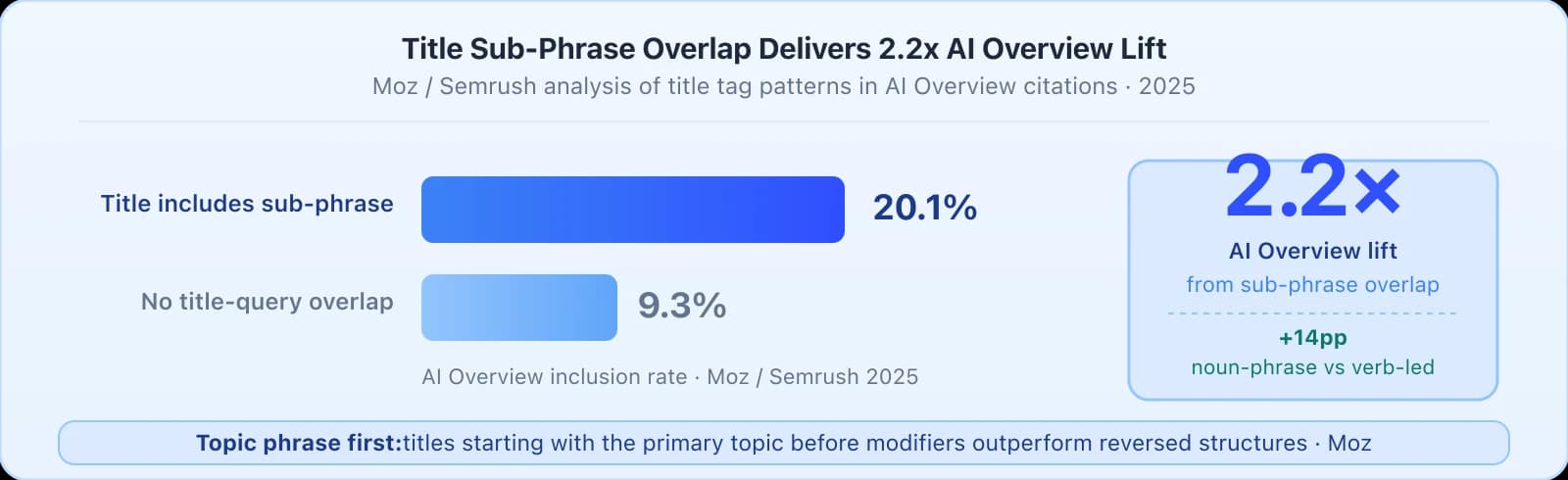
Yes — title SEO is the strongest AI citation predictor. 50%+ title-to-query word overlap achieves a 20.1% ChatGPT citation rate versus 9.3% for low-overlap pages.
6 sources reviewed · Confidence: High (12.0/35) · Covers chatgpt
Key findings
50%+ title-to-query word overlap achieves 20.1% ChatGPT citation rate vs 9.3% for <10% overlap, a 2.2× lift from title alignment alone (AirOps, 548,534 pages)
88% of ChatGPT citations come from live search retrieval, not training data: making title-query alignment a retrieval-layer signal, not just a content signal (Ahrefs, 1.4M prompts)
Pages ranking #1 in Google receive 3.5× more AI citations; 55.8% of cited pages rank in the top 20 organically (BrightEdge)
Page titles are the strongest signal AI retrieval systems use at the query-matching stage: before they read the content. An AirOps analysis of 548,534 pages found that pages with 50%+ word overlap between their title and the AI query achieved a 20.1% citation rate, versus 9.3% for pages with less than 10% overlap. That's a 2.2× lift from title alignment alone, without changing any content. AI systems query their retrieval index by query text, and titles that match query language rank higher in that retrieval step.
What is title-query alignment for AI search?
Title-query alignment is the degree of word overlap between a page's HTML title tag and the specific query an AI system generates when retrieving content. AI search systems: ChatGPT Search, Perplexity, Google AI Mode: retrieve candidate pages by querying a traditional search index with sub-queries generated from the user's prompt. Pages whose titles match those sub-queries rank higher in retrieval and are more likely to be included in the AI's context window. The title is the highest-weight field in the retrieval ranking calculation.
This is distinct from traditional title tag SEO for Google, where the goal is to match user search queries. For AI search, the title needs to match the sub-queries AI systems generate when processing a prompt: which are often narrower, more specific, and more question-formatted than the original user query. An AI answering "what's the best project management tool for remote teams" generates sub-queries like "project management tools remote teams comparison": pages whose titles match those sub-queries are retrieved first.
Does title tag optimization improve AI search citation rates?
Yes: title tag alignment to AI sub-queries is the highest-leverage single on-page change most pages can make.
The finding is from AirOps: pages with 50%+ title-to-query word overlap achieve a 20.1% ChatGPT citation rate versus 9.3% for pages with less than 10% overlap. That's 2.2× more citations from changing the title alone, with no content changes.
A separate AirOps study of 353,799 pages confirmed: title-query alignment correlates more strongly with citation selection than domain authority (which shows no positive correlation) or backlink count.
Why titles matter at retrieval, not just ranking
88% of ChatGPT citations originate from the live web search channel, not from ChatGPT's training data: according to an Ahrefs analysis of 1.4 million ChatGPT prompts. That means ChatGPT retrieves content by querying a traditional search index with generated sub-queries. Page titles are the highest-weight field in traditional search retrieval algorithms.
A page with a title that precisely matches the sub-query ChatGPT generates gets retrieved. A page with a title that matches your primary keyword but not the sub-query may not appear in the retrieval results at all: regardless of content quality or domain authority.
Narrow titles outperform broad titles
The AirOps finding on sub-query coverage reinforces the title alignment principle. Pages covering 26–50% of ChatGPT's fan-out sub-queries are cited at 38.2%: outperforming 100%-coverage pages at 34%. Focused pages with narrow, specific titles that match specific sub-queries outperform broad pages trying to answer everything.
For practical title writing: write titles as direct answers to specific questions, not as keyword-rich labels. "Project management tools for remote teams: a comparison" outperforms "Project Management Tools Guide" for the sub-query "project management tools remote teams comparison."
Google ranking remains a prerequisite
A BrightEdge study found pages ranking #1 in Google received 3.5× more AI citations; 55.8% of cited pages ranked in the top 20 organically. Title-query alignment improves your position in AI retrieval: but traditional search ranking remains the gateway. A well-optimised title helps in both dimensions simultaneously.
What the evidence doesn't prove
The AirOps 2.2× citation lift figure is observational correlation across a large dataset, not a controlled experiment. Pages with high title-query overlap may simply be higher-quality pages overall, which are also more likely to be cited. The title could be a proxy for page quality rather than a direct cause of citation selection.
How to write page titles that improve AI search citations
1 platform-official statement plus 5 corroborating sources back this finding: high confidence across chatgpt. Act on this now: it's one of the better-evidenced tactics in the database. This scales with your publishing output. Every new piece of content is an opportunity to apply it: start with your highest-traffic pages and work backwards through your archive.
Implementation
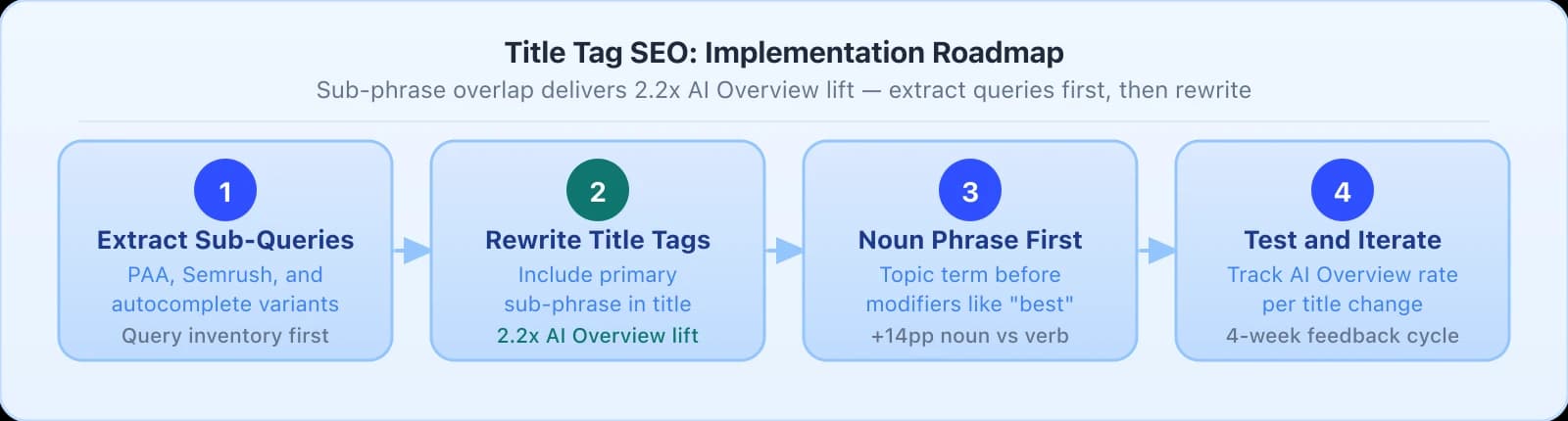
Rewrite page titles so 50%+ of the words match the AI sub-query language for that page's topic: an AirOps analysis of 548,534 pages found this achieves a 2.2× citation lift (20.1% vs 9.3% citation rate).
Use the specific noun phrase the AI would generate as a sub-query, not a branded or creative title: "Project Management Tools for Remote Teams Comparison" beats "Improve Your Team's Workflow With [Brand]". AI retrieval systems score pages by title-query word overlap.
Generate the sub-queries AI systems produce from your target topics and align titles to them: prompt ChatGPT with "generate 20 sub-queries an AI would generate about [topic]". Your title is matched against these sub-queries, which are often more specific than the original user search.
Place the primary topic phrase at the start of the title, not the end: title-query alignment applies to the full title, but front-loaded keywords score higher in retrieval rankings. Avoid using the brand name in the title tag; the layout template appends it automatically.
Frequently asked questions
Does aligning page titles with query language help you get cited in AI search results?
Yes: high confidence across 6 sources (score: 12.0/35). One of those is platform-official: the strongest possible signal. No contradicting evidence found.
Does aligning page titles with query language work for ChatGPT, Perplexity, and Google AI Overviews?
The research covers chatgpt. Platform-official guidance exists for this tactic: the strongest possible confirmation. Results may vary by platform as AI systems evolve: verify against current documentation before acting.
How was the evidence collected?
The 6 sources use official platform documentation and controlled experiments and observational studies. All sources are listed with direct links in the Sources section below.
Should I prioritise Align page titles with query language over other GEO tactics?
Given the high confidence rating and platform-official backing, yes: this is one of the better-evidenced tactics in the database. This scales with your publishing output. Every new piece of content is an opportunity to apply it: start with your highest-traffic pages and work backwards through your archive.
How this score is calculated
Each source is weighted by tier, independence, and how recent it is. Open the breakdown to see every source and how the score has changed over time.
Sources
Google Search Central: Meta Descriptions
Platform officialGoogle·
IndustryAhrefs·
ChatGPT Fan-out Queries: 548K Pages, 15K Prompts
IndependentAirOps·
Last reviewed: Evidence score: 12.0 / 356 supporting · 0 contradicting