Most off-page GEO advice still points first to backlinks and digital PR. The data says the strongest single off-page signal is somewhere else entirely. An Ahrefs analysis of 75,000 brands found YouTube channel mentions correlate with AI citation rates at 0.737 Spearman, above branded web mentions at 0.664-0.709 and roughly three times stronger than Domain Rating at 0.266-0.326. Separately, YouTube now accounts for 18.2% of non-ranking Google AI Overview citations, up 34% in six months. This post covers the two distinct mechanisms behind both numbers, and what to actually publish.
YouTube works through two separate mechanisms, not one
The first is training-data exposure. LLMs are trained on large volumes of text that include YouTube transcripts, video descriptions, and discussion of YouTube content elsewhere on the web. A brand that publishes consistently on a specific topic on YouTube creates brand-topic associations in training data that persist in model weights, independent of anything happening at retrieval time.
The second is retrieval-time authority. AI systems retrieve YouTube-hosted content directly, videos, transcripts, and channel descriptions, as first-class sources for relevant queries. ChatGPT Search retrieves YouTube content; Perplexity retrieves YouTube transcripts. For topics where video is the natural explanation format, tutorials, product comparisons, technical demonstrations, YouTube content competes directly with text-only pages for the citation.
Even a brand whose own site content is rarely retrieved directly can still benefit from the first mechanism, if its YouTube content is authoritative and topic-consistent enough to shape training-data associations.
| Off-page signal | Spearman correlation | Source |
|---|---|---|
| Domain Rating | 0.266-0.326 | Ahrefs, 75,000 brands |
| Branded web mentions (editorial, news, community) | 0.664-0.709 | Ahrefs, 75,000 brands |
| YouTube channel mentions | 0.737 | Ahrefs, 75,000 brands |
Source: Ahrefs, analysis of 75,000 brands, 2025-2026.
YouTube is also bypassing text ranking inside Google AI Overviews specifically
Separately from the training-data and retrieval mechanisms above, Ahrefs found YouTube is the single most-cited domain in Google AI Overviews and accounts for 18.2% of AIO citations that do not rank in Google's top 100 organic results. That share grew 34% over six months.
A citation that does not require top-100 organic ranking is a genuinely different opportunity than traditional SEO offers. If competitors in your topic area are producing video content, they may earn AI Overview placements that bypass text-based ranking entirely, regardless of how well your own pages rank.
Topic consistency matters more than production quality
The same principles that apply to text content apply here: original expert content on a narrow topic area, a consistent publishing cadence, specific data-backed claims, and clear topic-entity association with the brand.
Consistency of topic focus matters more than production value. A channel producing focused, specific videos on one professional topic is a stronger brand-entity signal than a channel producing high-production videos across unrelated topics, because the signal AI systems are building is a topic association from the pattern across videos, not a quality score on any single one.
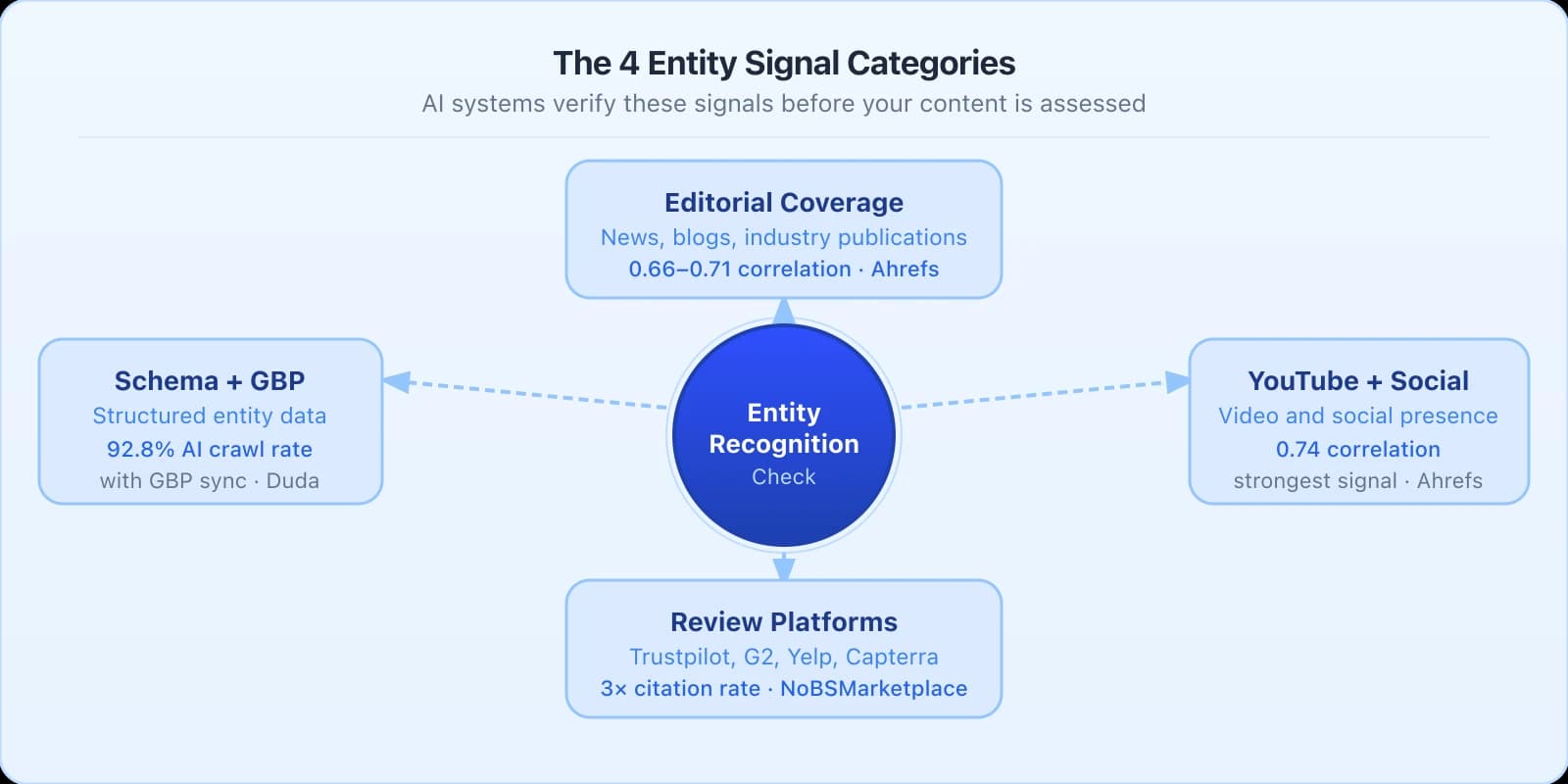
This connects directly to knowledge graph presence more broadly: YouTube is one of four entity-signal categories that build the same underlying credibility AI systems check before evaluating content, alongside editorial coverage, review platforms, and schema markup.
(This is observational correlation from a large cross-brand dataset, not a controlled experiment. Brands with strong YouTube presence tend to simultaneously have larger marketing budgets and broader content investment across every channel, which makes isolating YouTube specifically as the causal factor difficult. There is also no published controlled study comparing a YouTube-first strategy against an editorial-first one head to head.)
Treat 0.737 as a strong directional signal, not a guaranteed timeline. But if you are ranking off-page investment by leverage, this data puts a consistent, narrowly-focused YouTube channel ahead of backlinks and above generic digital PR, not behind them.