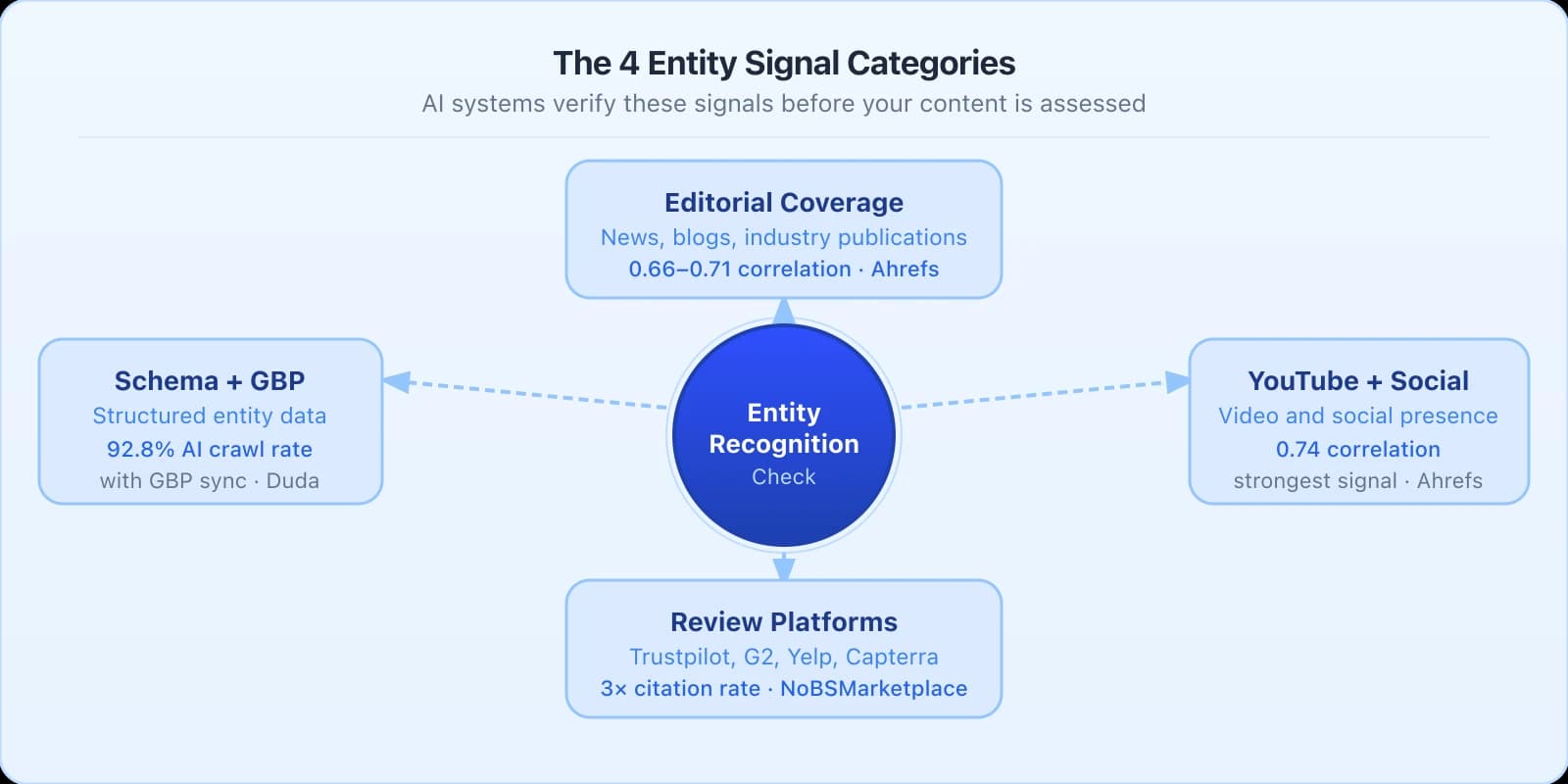
Most SEO teams track Domain Rating as their primary authority metric. An Ahrefs analysis of 75,000 brands found it is the weakest predictor of AI citation rates in the dataset. Branded web mentions correlate three times more strongly. This post covers what entity SEO for AI search actually measures, and why the signal most teams optimise is not the one AI systems check first.
Do AI systems check brand entity before reading content?
When someone asks an AI "best CRM for small teams," there is a 53% chance the response includes a brand the user never mentioned. That is from a Moz experiment run across major AI platforms, and it holds consistently across generic category queries.
The AI selected that brand before any user intent pointed at it. Brands are either in the selection pool or they are not, and that decision happens before content gets read.
Two peer-reviewed arXiv studies confirm the mechanism. One found that authority-guided filtering substantially improves AI answer accuracy: source credibility is an active gate, not a correlated trait. A second, tested via A/B testing on a live commercial platform, confirmed the filter runs at retrieval, before content quality is assessed at all.
Why does Domain Rating predict AI citations so poorly?
The Ahrefs study measured Spearman correlation between several signals and AI citation rates across 75,000 brands. Domain Rating, the metric most SEO reporting leads with, correlated at 0.266-0.326.
Branded web mentions correlated at 0.664-0.709. Roughly three times stronger.
YouTube channel mentions hit 0.737, the single strongest signal in the study.
(This is correlation research, not a controlled experiment. But a gap this large, between the metric most teams track and the metrics that actually predict citation, is hard to ignore.)
| Signal | Correlation with AI citations | Source |
|---|---|---|
| Domain Rating | 0.266-0.326 | Ahrefs, 75,000 brands |
| Branded web mentions | 0.664-0.709 | Ahrefs, 75,000 brands |
| YouTube channel mentions | 0.737 | Ahrefs, 75,000 brands |
Source: Ahrefs, AI brand visibility correlations study, 75,000 brands.
Do community platforms outrank brand websites in AI citations?
Yes: across 30 million sources tracked by NoBSMarketplace, the most-cited domains across AI platforms are Reddit, YouTube, LinkedIn, Wikipedia, Forbes, and Yelp, community and editorial platforms, not brand-owned websites.
This is the part that breaks conventional SEO instinct: the properties that predict AI citation most strongly are ones your brand does not control. Editorial coverage and genuine community presence outrank the on-site work most content teams spend their time on.
Do review platforms like G2 and Trustpilot help AI search visibility?
Building editorial coverage takes months. Review platforms move faster. Businesses with active profiles on Trustpilot, G2, Capterra, or Yelp show up in AI responses at roughly 3x the rate of those without, per the NoBSMarketplace analysis.
For recommendation queries specifically, Yext research found 46.3% of AI citations for "best X for Y" queries come directly from directories and review platforms, not brand websites and not editorial publications.
Across all query types, not just recommendations, a separate Yext study of 6.8 million citations found directories account for 42% of AI citations, second only to brand websites at 44%.
Review profiles are not editorial endorsement. But they are cross-referenceable records that confirm your brand exists somewhere other than your own website, which is exactly what the entity filter checks for.
Does schema markup earn AI citations on its own?
No, not on its own: schema markup raises how often AI systems crawl a page, not how often they cite it. A Duda study of 858,457 business locations found structured schema markup lifted AI crawl rate to 72.3%, versus 55.2% without it.
AI systems cannot cite entity data they cannot read, so Organization schema with sameAs links to Wikipedia, LinkedIn, and Crunchbase is a precondition for citation, not a citation signal itself. Add the schema. Then go build the mentions it points to.
Does Google Business Profile sync affect AI crawl rate?
Yes: the same Duda study of 858,457 business locations found businesses with synced Google Business Profiles were crawled by AI systems at 92.8%, versus 58.9% without a synced profile.
That lift happens before any citation or entity-mention signal is assessed. Syncing the profile is a precondition for being read at all, not a driver of citation on its own.
What should you build first for entity SEO?
Start with Organization schema and a Wikidata entry: these are fast, structural, and make every subsequent signal cross-referenceable. Then claim review platform profiles (Trustpilot, G2, Capterra, Yelp) for the faster visibility lift. In parallel, start building editorial mentions and a YouTube presence, which compound slower but carry the strongest correlation of any signal measured.
Does equal Domain Rating mean equal AI citation rates?
Two brands with identical Domain Ratings and identical content quality can have very different AI citation rates if one has off-site entity presence and the other does not. That gap will not show up in a standard SEO report, because standard SEO reports are built around the metric that correlates weakest with AI citation: Domain Rating.
The findings are observational, not causal: brands with strong editorial and YouTube presence may simply already be better known. But the practical action holds either way. Build the entity signals AI systems actually filter on, not the one your existing dashboard already tracks.