Yes — knowledge graph and entity signals directly improve AI citation rates. Content referencing 15+ connected entities shows 4.8x higher AI Overview selection probability; brands with multi-platform entity presence are cited even on queries that do not name them. Authority is the filter AI applies before assessing content quality — which means off-page entity signals are a prerequisite, not a bonus.
15 sources reviewed · Confidence: High (12.0/35) · Covers all
Key findings
53% of generic category queries return unprompted brand citations. AI systems select brands before any brand intent is expressed (Moz)
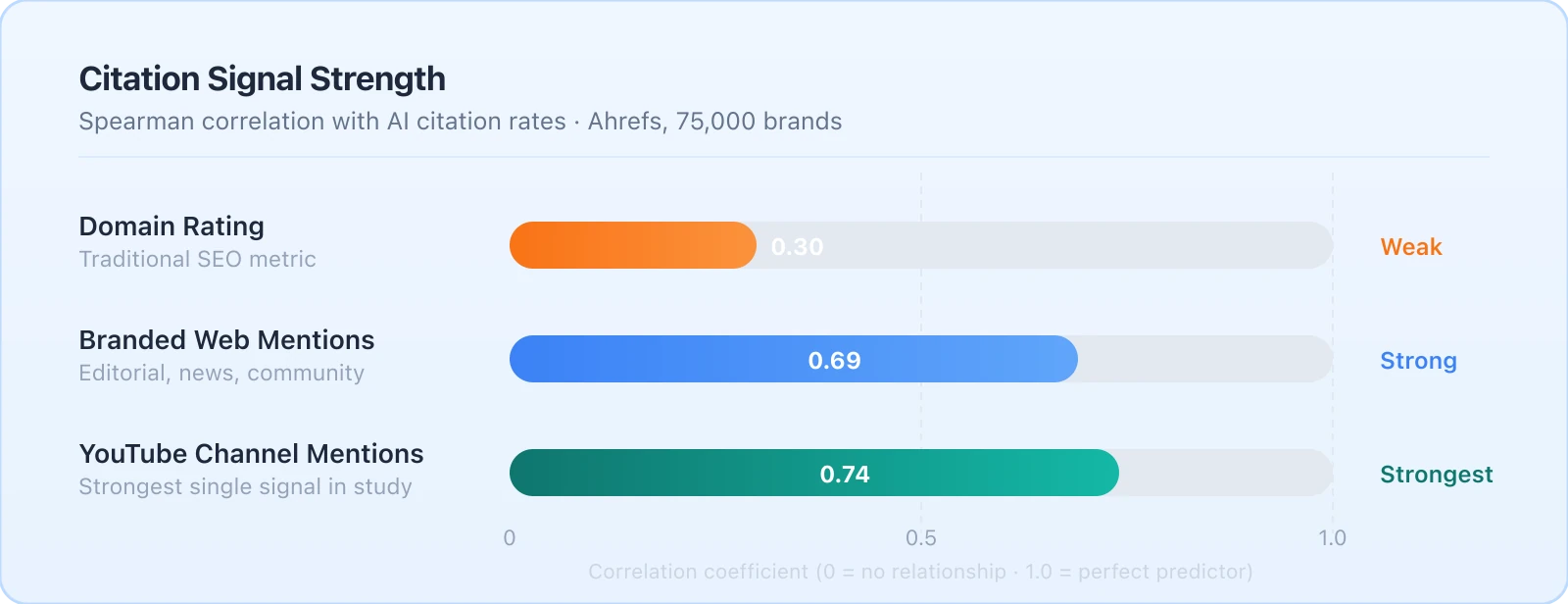
Branded web mentions predict AI citation rates 3× more strongly than Domain Rating: 0.664–0.709 vs 0.266–0.326 Spearman (Ahrefs, 75,000 brands)
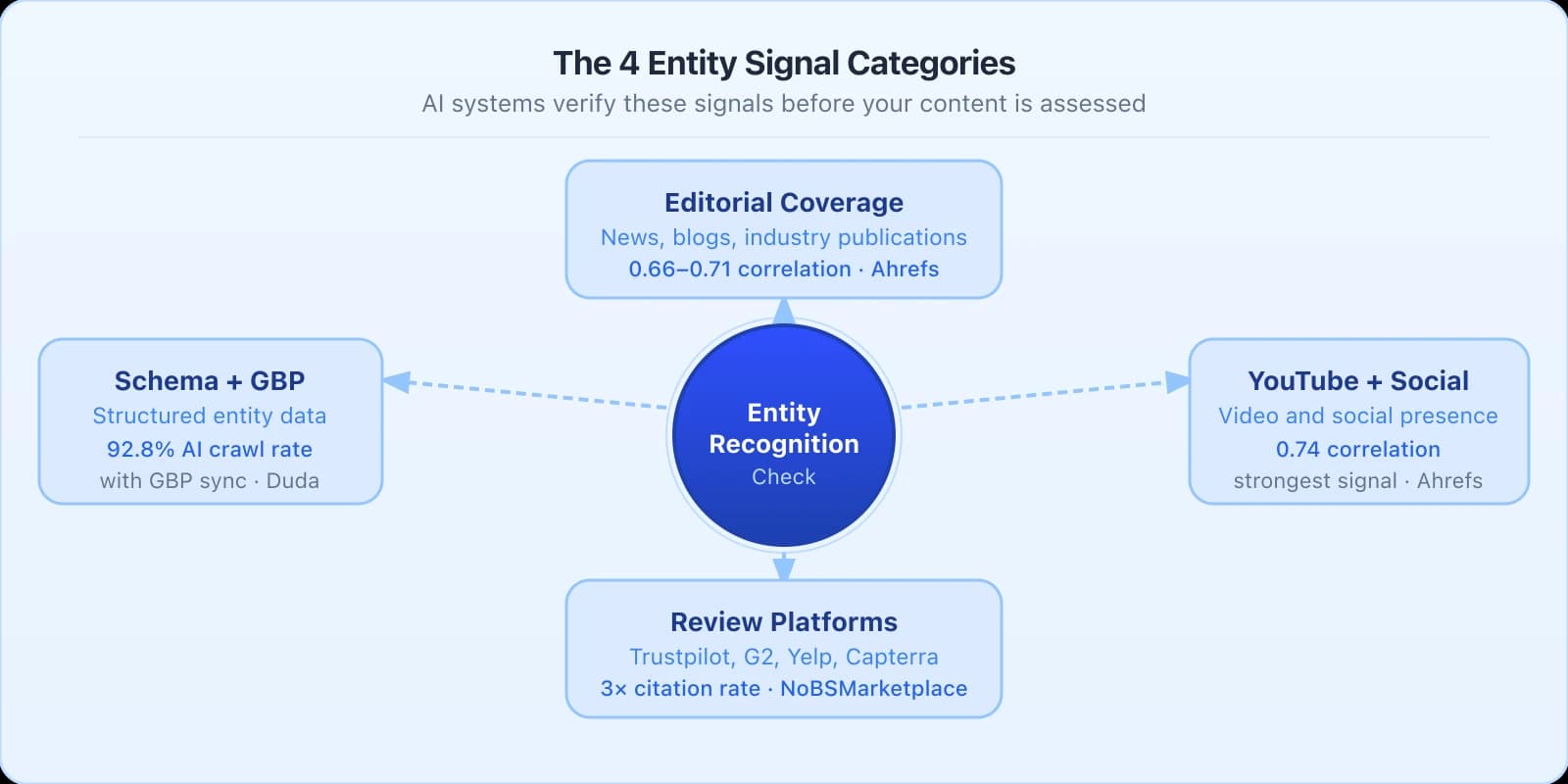
Businesses with review platform profiles (Trustpilot, G2, Yelp) are cited in AI responses at 3× the rate of those without (NoBSMarketplace)
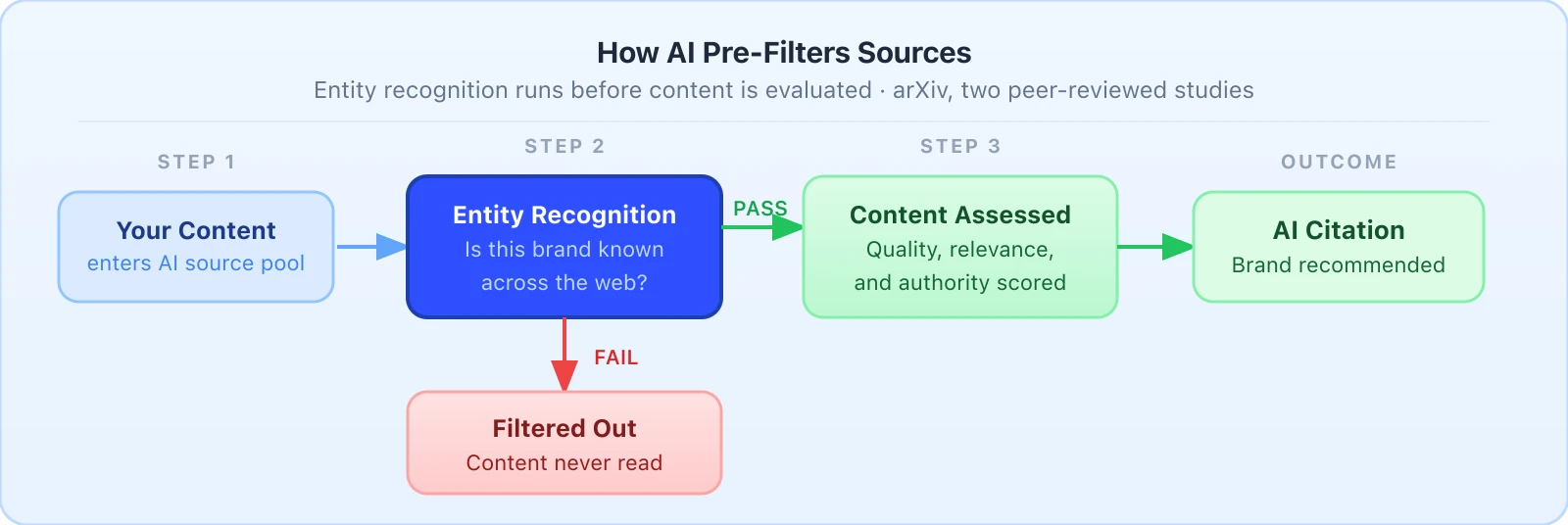
AI systems pre-filter content by source before evaluating what it says. Before your content is assessed, AI retrieval systems check whether your brand is a recognised entity in their knowledge bases, cross-referencing editorial coverage, community platform presence, directory listings, and review profiles. Most SEO tools don't measure any of those signals. This tactic is about building them.
What is knowledge graph SEO for AI search?
A knowledge graph is a structured database of real-world entities (brands, people, places, and concepts) and the relationships between them. Google's Knowledge Graph, Microsoft's Bing Entity Store, and the training corpora of major LLMs all use entity databases to organise knowledge about the world.
When AI retrieval systems evaluate which sources to cite, they cross-reference candidates against these knowledge bases. Brands with verified entity records (a Wikipedia entry, consistent directory presence, editorial mentions) pass this check as recognisable, citable entities. Brands that exist only as websites are harder to confirm.
Building knowledge graph presence means establishing your brand as a verified entity across two connected layers: structured records (schema.org Organization markup with sameAs links, a Wikidata entry, consistent directory listings) and editorial presence (genuine third-party mentions in publications that LLMs absorb during training and use to assess brand credibility at retrieval time). Neither layer can be built on your own site. Both compound slowly. Months, not days. And they are hard for competitors to replicate once established.
Does knowledge graph SEO improve AI search citations?
Yes. Here's what the evidence actually shows.
When someone asks an AI "best CRM for small teams," there's a 53% chance the response includes a brand the user never mentioned. The AI selected it before any brand intent was expressed.
That's from a Moz experiment run across major AI platforms. It holds consistently across generic category queries, not an edge case.
Brands are either in the selection pool or they're not. And that decision happens before your content is read.
So what determines whether you make the cut?
In an Ahrefs analysis of 75,000 brands, the weakest predictor was Domain Rating, the metric most SEO teams track most closely. It correlated at 0.266–0.326 with AI citation rates.
Branded web mentions correlated at 0.664–0.709. Roughly three times more strongly.
YouTube channel mentions hit 0.737, the single strongest signal in the study.
It's not about content quality. It's about whether the rest of the web talks about you: on editorial sites, on YouTube, in third-party sources. (This is correlation research, not a controlled experiment. But a gap that large is hard to ignore.)
That pattern holds in a separate dataset. Across 30 million sources tracked by NoBSMarketplace, the most-cited domains across AI platforms are Reddit, YouTube, LinkedIn, Wikipedia, Forbes, and Yelp. Community and editorial platforms, not brand websites.
How AI systems filter by source before reading content
AI systems don't start by reading your content. They filter first.
Sources not recognised as credible entities are screened out before their content is assessed at all. Two peer-reviewed arXiv studies confirm this sequence. One found that authority-guided filtering substantially improves answer accuracy. Source credibility is an active gate, not just a correlated trait. A second, tested via A/B testing on a live commercial platform, confirmed the filter runs at retrieval, not after.
A Beeby Clark+Meyler guide on off-page AI citation drivers reached the same conclusion: external credibility signals are a prerequisite for AI citation, not a secondary benefit.
That effect is strongest for niche brands. A separate arXiv study found that for topics where AI has limited pre-training knowledge, retrieval rank directly determines citation outcome. A brand recognised as an authority on a narrow topic is cited more consistently than a larger brand covering that topic superficially.
Your content needs to pass the entity recognition check before it gets read.
Two brands with identical Domain Ratings and identical content quality can have very different AI citation rates, if one has consistent off-site entity presence and the other doesn't. That gap won't appear in any standard SEO report.
Review platforms: a faster entry point
Building editorial coverage takes months. But there's a parallel starting point.
Businesses with active profiles on Trustpilot, G2, Capterra, or Yelp show up in AI responses at roughly 3× the rate of those without them. That's from a NoBSMarketplace analysis.
For recommendation queries like "best X for Y", Yext found that 46.3% of AI citations come from directories and review platforms directly. Not brand websites. Not editorial publications.
Across all query types, a separate Yext study of 6.8 million citations found directories account for 42% of AI citations: second only to brand websites at 44%. Reviews and social account for the remaining 8%. Directories are not a niche channel.
Review profiles aren't editorial endorsement. But they are cross-referenceable records that confirm your brand exists somewhere other than your own website.
Schema and Google Business Profile: making entity data readable
There's also a technical layer.
In a Duda study of 858,457 business locations, businesses with synced Google Business Profiles were crawled by AI systems at 92.8%, vs 58.9% without. Structured schema markup: 72.3% vs 55.2%.
A separate arXiv study found that Schema.org markup directly improves how accurately AI platforms identify and recommend brand entities, not just whether they crawl.
These are crawl rates, not citation rates. Being crawled doesn't guarantee being cited.
But AI systems can't include entity data they can't read. Schema markup and GBP sync are a precondition, not a differentiator.
What the evidence doesn't prove
The Moz and Ahrefs findings are observational. They show which brands get cited alongside which signals they have, not that building those signals caused the citations. Brands with strong editorial and YouTube presence may simply already be better-known.
The Moz experiment also only observes established brands. How long it takes an emerging brand to earn unprompted citations isn't measured.
One finding complicates the review platform picture. A December 2025 Yext study found review platform citations declined to 5.5%, down from the 8% measured in their October 2025 study, while brand-controlled sources rose to 90% of total AI citations. The review platform signal may be weakening as AI systems mature.
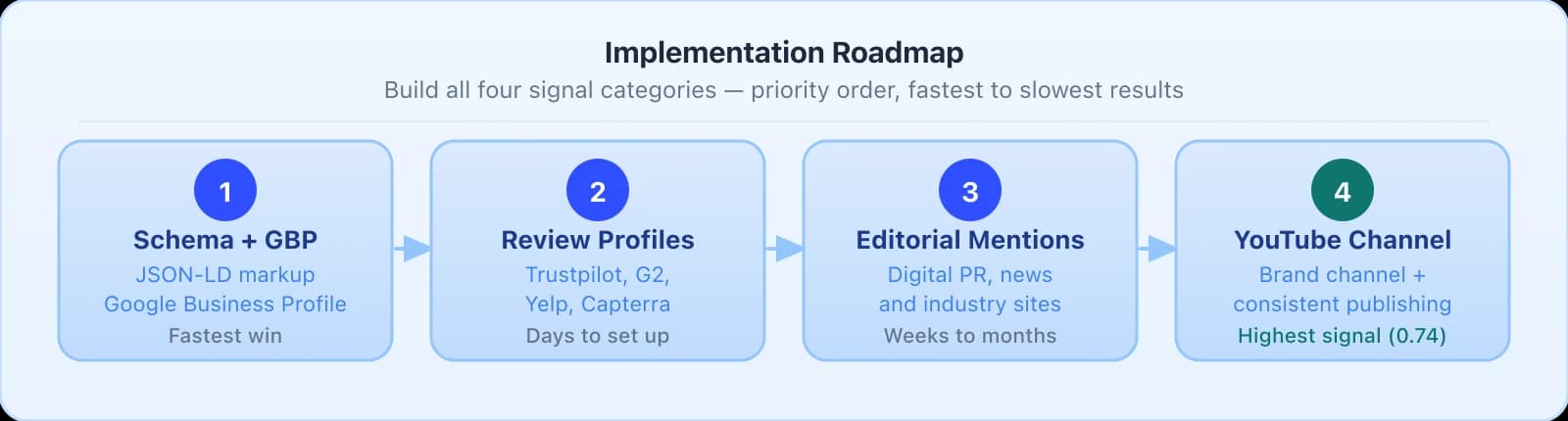
And the Duda numbers are crawl rates. Higher is better, but the study doesn't show they translate directly to being cited. Build all four signals: editorial mentions, review platform profiles, schema markup, GBP sync. Don't expect rapid results from any of them.
How to build knowledge graph presence: a step-by-step guide
1 platform-official statement plus 14 corroborating sources back this finding: high confidence across all. Act on this now: it's one of the better-evidenced tactics in the database. Authority signals take months to build and are difficult for competitors to replicate quickly. This is a long-term investment that compounds: the earlier you start, the wider the moat.
Implementation
Add Organization schema to your homepage and about page. Include name, url, description, and sameAs links to Wikipedia, LinkedIn, Crunchbase, and any authoritative directory where your brand is listed. The sameAs links are the operative element: they give AI systems cross-referencing points to confirm your on-site entity claims.
Claim or create a Wikidata entry for your brand. A Wikidata entity with verified attributes gives AI systems a structured, machine-readable identity record even without a full Wikipedia article.
Build editorial brand mentions and community presence: target at least 3 authoritative third-party publications per quarter and build a YouTube channel presence. An Ahrefs study of 75,000 brands found branded web mentions correlate with AI citation rates at 0.664–0.709 Spearman, roughly three times more strongly than Domain Rating (0.266–0.326). YouTube mentions correlated at 0.737, the strongest single signal in the study. Press releases and sponsored content do not count; editorial references and genuine community presence do.
Claim and complete profiles on Trustpilot, G2, Capterra, or Yelp. Third-party review platform presence reinforces your off-site entity footprint and provides additional sameAs-confirmable records for AI systems.
Frequently asked questions
Does building knowledge graph presence help you get cited in AI search results?
Yes: high confidence across 15 sources (score: 12.0/35). One of those is platform-official: the strongest possible signal. No contradicting evidence found.
Does building knowledge graph presence work for ChatGPT, Perplexity, and Google AI Overviews?
The research covers all. Platform-official guidance exists for this tactic: the strongest possible confirmation. Results may vary by platform as AI systems evolve: verify against current documentation before acting.
How was the evidence collected?
The 15 sources use official platform documentation and controlled experiments and observational studies. 4 sources are academic or peer-reviewed. All sources are listed with direct links in the Sources section below.
Should I prioritise Build knowledge graph presence over other GEO tactics?
Given the high confidence rating and platform-official backing, yes: this is one of the better-evidenced tactics in the database. Authority signals take months to build and are difficult for competitors to replicate quickly. This is a long-term investment that compounds: the earlier you start, the wider the moat.
How this score is calculated
Each source is weighted by tier, independence, and how recent it is. Open the breakdown to see every source and how the score has changed over time.
Sources
A new profile to help publishers and creators highlight their work on Search
Platform officialGoogle·
68 Million AI Crawler Visits: AI Crawling Analysis
IndependentDuda·
Brands mentioned on four or more platforms are 2.8 times more likely to appear in ChatGPT responses
IndependentThe Digital Bloom·
The Complete Guide to Off-Page AEO/SEO AI Visibility
IndependentBeeby Clark+Meyler·
AI Visibility 2026: What Gets Brands Cited
IndustryNoBSMarketplace·
AI Citation Behavior Across Models
IndustryYext·
AI Citations, User Locations, & Query Context
IndustryYext·
Last reviewed: Evidence score: 12.0 / 3515 supporting · 0 contradicting
Related analysis