Yes — schema markup improves AI search entity understanding. JSON-LD Article, FAQ, and HowTo data helps AI systems identify entities and relationships on your page.
24 sources reviewed · Confidence: High (12.0/35) · Covers google-aio
Key findings
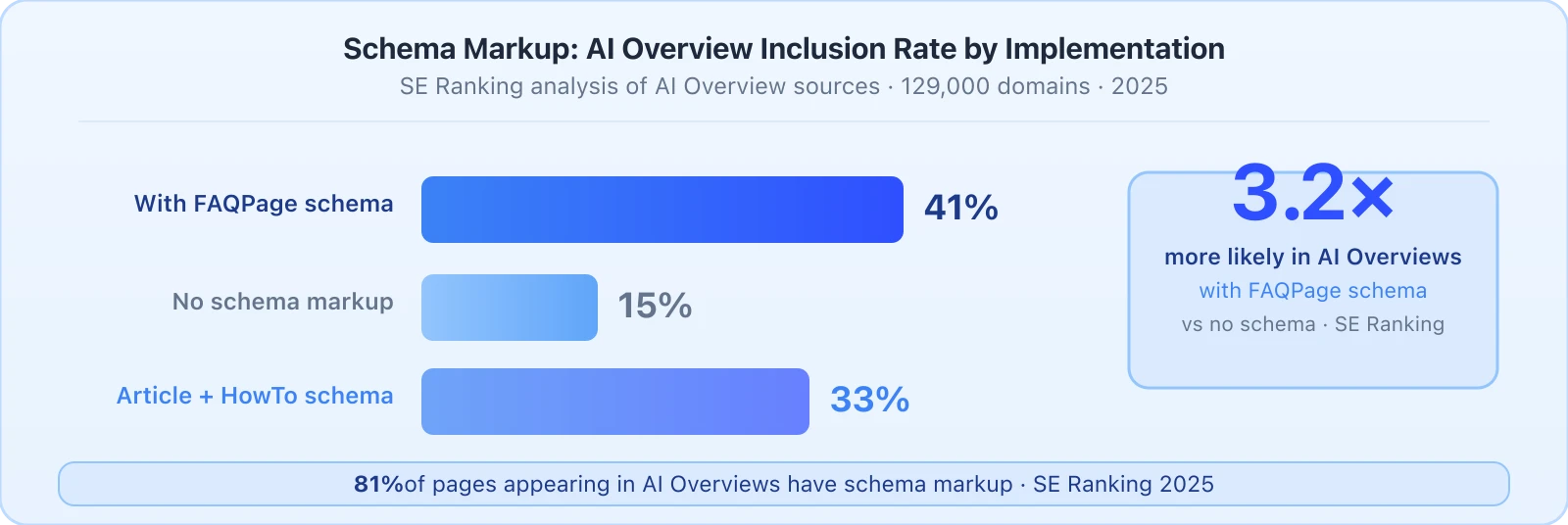
FAQ schema pages appear in Google AI Overviews 3.2× more often: 41% citation rate vs 15% without FAQ schema (Onely)
81% of AI-cited pages include schema markup; metadata and freshness signals show strongest citation correlation at r=0.68 (AccuraCast, 9,000 citations; arXiv, cross-platform)
Document structure alone drives 17.3% average citation improvement: heading architecture accounts for 44.9% of that gain, more than sentence-level content quality (arXiv)
Schema markup's relationship with AI search is more indirect than most practitioners expect. A Writesonic analysis of 6 AI crawlers found that JSON-LD: the format Google recommends: scored 0 out of 6 for readability across all crawlers tested. AI systems are not parsing your structured data directly. But an [Onely study](https://www.onely.com/blog/how-to-rank-in-google-ai-overviews/) found that pages with FAQ schema appeared in Google AI Overviews at 3.2× the rate of unstructured pages. The mechanism isn't direct parsing: it's that schema markup improves your position in traditional search, and AI search systems draw heavily from the same retrieval pool. Understanding this distinction changes what schema work you prioritise.
What is schema markup for AI search?
Schema markup is machine-readable metadata embedded in a page's HTML that describes its content in a format structured for automated systems. For AI search, it operates through three layers. First, schema improves how your page is understood and ranked by traditional search engines: particularly Google: which remain the primary retrieval pool for AI search systems like Google AI Overviews. Second, certain schema types (Article with datePublished and dateModified, Organization with sameAs links, Person with linked credentials) provide entity-level signals that AI systems use to assess source credibility, even when they are not parsing the JSON-LD directly. Third, structured data contributes to document-level legibility: an arXiv study found that document structure accounts for 17.3% of average citation improvement, with macro-structure (headings, schema, metadata) driving 44.9% of that gain.
The most commonly cited schema types in AI-visible pages are Article schema (with author and date fields), Organization schema with sameAs links, and Person schema. FAQPage schema correlates with AI Overview inclusion rates despite being restricted for Google rich results on non-health/government sites. The common thread is entity completeness: schema that makes your page's authorship, freshness, and topic explicit gives AI systems more surface area to assess citation worthiness.
Does schema markup improve AI search citation rates?
Yes: but the mechanism is indirect, and understanding why changes what you implement first.
An Onely study found FAQ schema pages appear in Google AI Overviews at 3.2× the rate of unstructured pages, a 41% citation rate versus 15% without FAQ schema. That's a large effect. But a separate Writesonic analysis of 6 AI crawlers found that JSON-LD: Google's recommended format: scored 0 out of 6 for direct readability across all crawlers. The AI crawlers are not parsing your structured data. So how does the lift happen?
The answer is that schema markup improves your position in traditional search (particularly Google and Bing), and AI search systems like Google AI Overviews and SearchGPT draw their retrieval pool from traditional search rankings. FAQ schema doesn't signal to AI crawlers directly: it improves page standing in the retrieval pool that AI systems draw from.
81% of AI-cited pages include schema markup
An AccuraCast analysis of 9,000 AI citations found that 81% of cited pages included some form of schema markup, versus 19% without. FAQPage schema was only present in 1.8% of cited sources: the 81% figure is dominated by Article schema, Organization schema, and structured metadata more broadly.
An arXiv study run across Brave, Google, and Perplexity found metadata and freshness signals showed the strongest correlation with citation rates (r=0.68), followed by semantic HTML (r=0.65) and structured data (r=0.63). These are correlational findings: r=0.63 for structured data represents a meaningful but not deterministic signal.
Document structure has its own independent effect
A separate arXiv study tested document structure independently of content quality. Structure alone drove a 17.3% average citation improvement. Macro-structure: heading architecture, schema presence, metadata: accounted for 44.9% of that gain. Meso-structure (paragraph organisation) for 39.7%. Micro-structure (sentence-level) for 15.4%.
The practical reading: heading architecture and Article schema contribute more to citation rates than sentence-level writing quality. That's a significant finding for content teams that prioritise prose polish over structural markup.
The Bing factor
A Seer Interactive study found that 87% of SearchGPT citations match Bing's top organic results. Schema and technical SEO that improves Bing rankings has an outsized AI citation payoff: work done once for Bing flows through to SearchGPT at a rate that equivalent Google-first SEO effort doesn't match.
What the evidence doesn't prove
The Onely correlation between FAQ schema and AI Overview appearance cannot isolate schema as the cause. Pages with FAQ schema also tend to be better-structured overall, which may explain part of the lift.
The Writesonic finding that JSON-LD is unreadable to AI crawlers contradicts the intuition that schema directly improves AI comprehension. The indirect effect through traditional search rankings is real. But the expected mechanism: AI reads your schema and extracts entity data: is not how it works in practice for most platforms.
How to implement schema markup for GEO and AEO
8 platform-official statements plus 16 corroborating sources back this finding: high confidence across google-aio. Act on this now: it's one of the better-evidenced tactics in the database. Unlike content tactics, this is binary: either your technical setup passes the bar or it doesn't. Audit first, fix second. Technical debt here blocks every downstream optimisation. Note: 4 sources contradict this: review the contradicting evidence section before acting.
Implementation
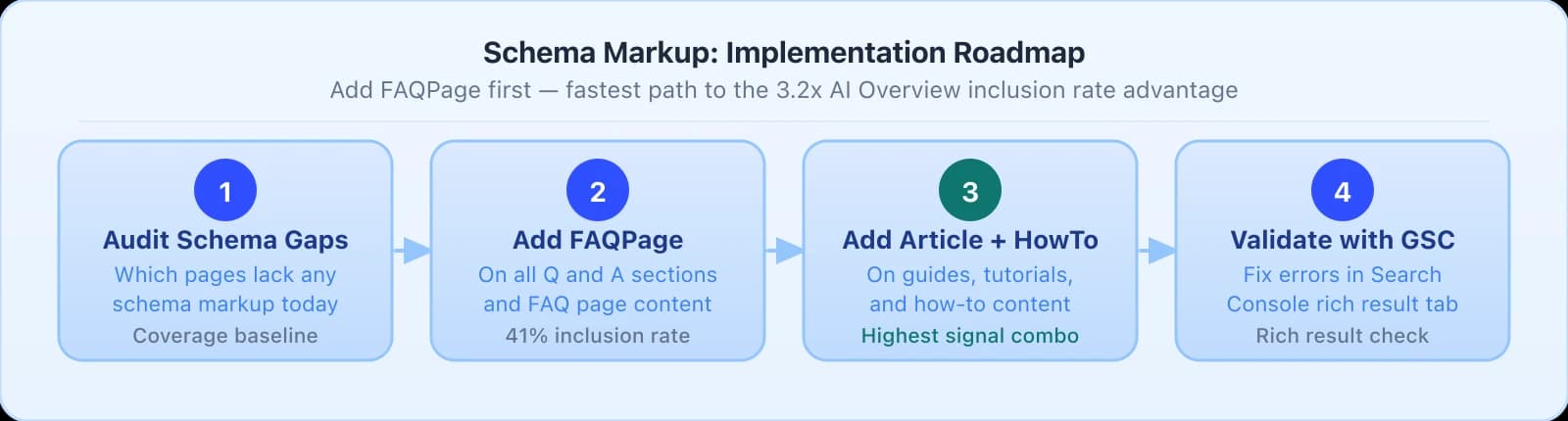
Add FAQPage schema to any page with a Q&A section. Use the exact question/answer text from the visible page content.
Add HowTo schema to step-by-step guides: AI systems use HowTo markup to extract structured instructional content.
Add Article schema (with datePublished and dateModified) to all editorial content: publication dates are a freshness signal AI systems use at retrieval time.
Validate all schema using schema.org Validator and Google's Rich Results Test before deploying.
Does any research contradict this?
5 sources contradict this tactic. Consider these findings alongside the supporting evidence before acting.
JSON-LD structured data — Google's recommended schema implementation format — is invisible to all 6 AI crawlers tested (0/6 readability score). Meta descriptions and Open Graph tags score equally low: 0/6. Only the <title> tag achieves reliable readability across AI crawlers (5/6). This directly challenges the assumption that implementing schema markup improves AI citation rates through metadata signals. The practical implication: schema markup may benefit traditional search crawlers and humans but does not influence how current AI crawlers ingest page metadata. Content signal, not metadata signal, drives AI discoverability.
“9 of 11 metadata elements scored 0/6 — including JSON-LD, which Google recommends but AI crawlers cannot read. The title tag was the only metadata element readable by 5 of 6 crawlers.”
Industry Writesonic · Mar 2026 · contradicts
JSON-LD structured data — Google's recommended schema implementation format — is invisible to all 6 AI crawlers tested (0/6 readability score). Meta descriptions and Open Graph tags score equally low: 0/6. Only the <title> tag achieves reliable readability across AI crawlers (5/6). This directly challenges the assumption that implementing schema markup improves AI citation rates through metadata signals. The practical implication: schema markup may benefit traditional search crawlers and humans but does not influence how current AI crawlers ingest page metadata. Content signal, not metadata signal, drives AI discoverability.
“9 of 11 metadata elements scored 0/6 — including JSON-LD, which Google recommends but AI crawlers cannot read. The title tag was the only metadata element readable by 5 of 6 crawlers.”
Industry Writesonic · Mar 2026 · contradicts
Schema markup did not improve AI citations: controlled experiment with 1,885 treatment pages and 4,000 controls across three platforms (ChatGPT, AI Mode, AI Overview); schema addition yielded 2.4% gain on AI Mode, 2.2% on ChatGPT (both statistically insignificant), and 4.6% decline on AI Overview (statistically significant negative).
“Ahrefs research shows pages cited by AI were almost three times more likely to include JSON-LD than those that weren't cited. They tracked 1,885 pages that added JSON-LD between August 2025 and March 2026, compared them to 4,000 control pages, and carefully examined citation patterns across three different platforms. Interestingly, adding schema didn't significantly boost citations for any platform. For AI Mode, citations increased by 2.4% compared to controls, and for ChatGPT, by 2.2%, but Ahrefs considered these differences statistically insignificant. Citations for AI Overview fell by 4.6%, a small yet statistically significant decrease.”
Industry Ahrefs · Sep 2026 · contradicts
Adding JSON-LD schema to 1,885 pages resulted in a 4.6% decline in AI Overview citations relative to control pages, with AI Mode and ChatGPT showing statistically insignificant changes of +2.4% and +2.2% respectively.
“Ahrefs matched each treated page against controls that never added schema and measured changes over 30-day windows. AI Overviews showed a 4.6% decline relative to controls, while AI Mode (+2.4%) and ChatGPT (+2.2%) showed changes too small to distinguish from noise.”
Industry Ahrefs · May 2026 · contradicts
A controlled study found that schema markup does not function as a citation cheat code for AI search results.
“a controlled study says it is not”
Industry No Hacks · Jul 2026 · contradicts
Frequently asked questions
Does implementing JSON-LD schema markup help you get cited in AI search results?
Yes: high confidence across 24 sources (score: 12.0/35). 8 are platform-official: the strongest possible signal. 4 sources contradict this: see the contradicting evidence section before acting.
Does implementing JSON-LD schema markup work for ChatGPT, Perplexity, and Google AI Overviews?
The research covers google-aio. Platform-official guidance exists for this tactic: the strongest possible confirmation. Results may vary by platform as AI systems evolve: verify against current documentation before acting.
How was the evidence collected?
The 24 sources use official platform documentation and controlled experiments and observational studies. 6 sources are academic or peer-reviewed. All sources are listed with direct links in the Sources section below.
Should I prioritise Implement JSON-LD schema markup over other GEO tactics?
Given the high confidence rating and platform-official backing, yes: this is one of the better-evidenced tactics in the database. Unlike content tactics, this is binary: either your technical setup passes the bar or it doesn't. Audit first, fix second. Technical debt here blocks every downstream optimisation.
How this score is calculated
Each source is weighted by tier, independence, and how recent it is. Open the breakdown to see every source and how the score has changed over time.
Sources
AI features in Google Search: your questions, answered
Platform officialGoogle Search Central
Canonicalization troubleshooting guide
Platform officialGoogle·
Introducing the Open Knowledge Format
Platform officialGoogle Cloud·
Platform officialOpenAI·
Platform officialGoogle Cloud·
Platform officialGoogle·
Article structured data | Google Search Central
Platform officialGoogle·
AI Shopping Visibility Insights
Platform officialGoogle·
ChatGPT's Own Index Served Sites Without Deals The Same Way
IndependentResoneo·
Content Types & Formats That Earn Mentions in LLMs
AcademicOnely·
IndependentPrevisible·
AI Crawler Analysis: 858,457 Sites, 68.9 Million Visits
IndependentDuda·
68 Million AI Crawler Visits: AI Crawling Analysis
IndependentDuda·
Bing Rankings Drive ChatGPT Visibility More Than Google — New Study
IndependentSearch Engine Land·
Visibility in ChatGPT and LLMs
IndustryUberall·
AI Crawler Study: What 60+ Tests Across 6 LLMs Reveal
IndustryWritesonic·
87% of SearchGPT Citations Match Bing's Top Results
IndependentSeer Interactive·
Schema Markup Impact on AI Search: Study of 9,000 Citations
IndustryAccuraCast·
AI Crawler Study: What 60+ Tests Across 6 LLMs Reveal
IndustryWritesonic· March 2026· contradicts
IndustryAhrefs· September 2026· contradicts
Schema Markup Didn't Move AI Citations In Ahrefs Test
IndustryAhrefs· May 2026· contradicts
IndustryNo Hacks· July 2026· contradicts
Last reviewed: Evidence score: 12.0 / 3524 supporting · 4 contradicting
Related analysis