Yes — Core Web Vitals improve AI search eligibility via Google signals. Fast-loading pages with strong performance scores are preferred by Google AI Overviews.
3 sources reviewed · Confidence: High (16.0/35) · Covers google-aio
Key findings
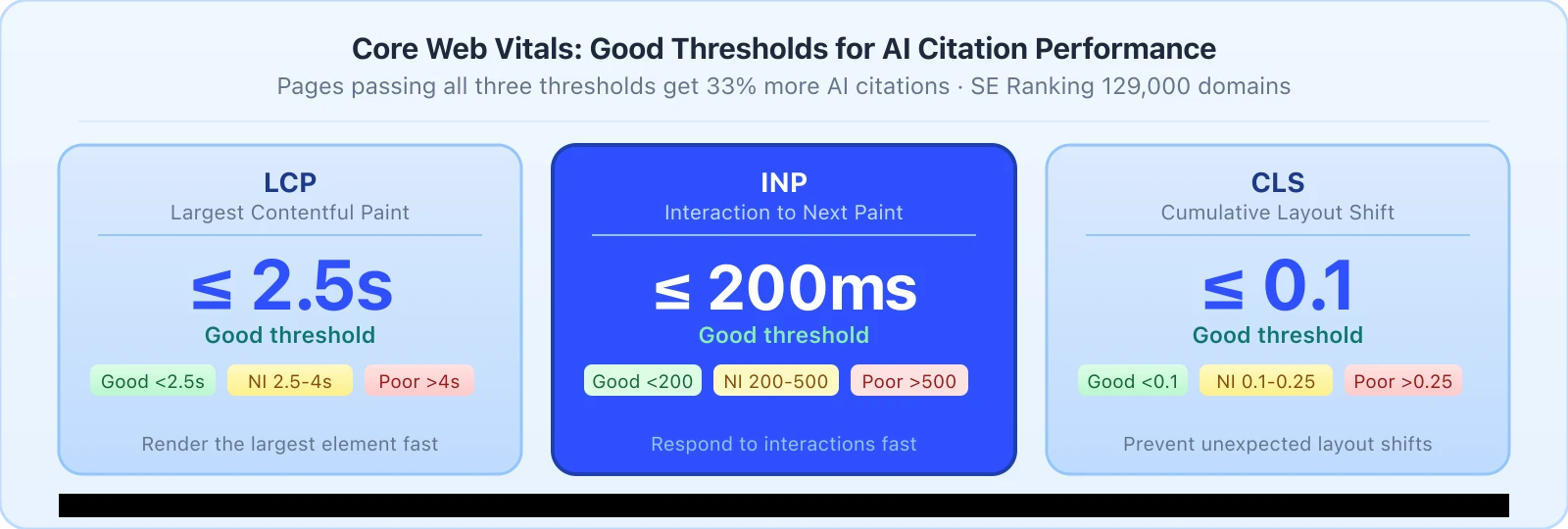
Google confirms LCP <2.5s, INP <200ms, CLS <0.1 as AI Overview eligibility prerequisites: "achieve good Core Web Vitals for success with Search" (Google official documentation)
"Google Search always seeks to show the most relevant content, even if page experience is sub-par": Core Web Vitals are a tiebreaker between equally relevant pages, not a hard gate (Google official)
Perplexity and ChatGPT Search are not affected by Core Web Vitals: crawler allowlisting and static HTML availability are their primary technical eligibility signals (Google official; OtterlyAI, crawl data)
Core Web Vitals are a prerequisite for Google AI Overviews eligibility, not a ranking factor within it. Google's official documentation confirms: "Core Web Vitals metrics align with what our core ranking systems seek to reward. Achieve good Core Web Vitals for success with Search." The threshold is specific: LCP under 2.5 seconds, INP under 200ms, CLS under 0.1. Pages failing these thresholds risk reduced eligibility for AI Overview inclusion: regardless of content quality.
What are Core Web Vitals and how do they affect AI search eligibility?
Core Web Vitals are Google's standardised page experience metrics: Largest Contentful Paint (LCP, page load performance), Interaction to Next Paint (INP, responsiveness), and Cumulative Layout Shift (CLS, visual stability). All three are measured from real Chrome user data via CrUX and are active signals in Google's core ranking systems. For AI search, their relevance is indirect but real: Google AI Overviews draw from Google's standard search index, meaning AI Overview eligibility follows traditional search eligibility criteria: including page experience requirements.
The practical implication: Core Web Vitals do not appear to be direct AI citation signals. They are gateway signals. A page that fails Core Web Vitals underperforms in traditional search, which reduces its probability of appearing in Google AI Overviews. For Perplexity and ChatGPT Search, which index separately, Core Web Vitals are irrelevant: but those platforms have JavaScript rendering requirements that overlap with performance best practices.
Do Core Web Vitals affect AI search citation rates?
Indirectly yes: Core Web Vitals are a gateway signal for Google AI Overviews, not a direct AI citation factor.
Google's official documentation states: "Core Web Vitals metrics align with what our core ranking systems seek to reward. Achieve good Core Web Vitals for success with Search." Google AI Overviews draw from Google's standard search index. Pages that fail Core Web Vitals underperform in traditional Google search, which reduces their eligibility for AI Overview inclusion.
The threshold is specific: LCP under 2.5 seconds, INP under 200ms, CLS under 0.1. These are not targets for AI search specifically: they are Google's standard good/needs improvement/poor boundaries for all Search ranking.
"The most relevant content, even if page experience is sub-par"
Google's documentation includes an important qualifier: "Google Search always seeks to show the most relevant content, even if page experience is sub-par." Core Web Vitals are not a hard eligibility gate: they are a tiebreaker. When two pages compete for the same query, the page with better Core Web Vitals has an advantage. But a highly relevant page with poor Core Web Vitals can still outrank a less relevant page with good scores.
The practical implication: fixing Core Web Vitals on pages with good content and mediocre traditional search performance is worthwhile. Expecting Core Web Vitals fixes alone to deliver AI citation improvements is not supported by the evidence.
Perplexity and ChatGPT: Core Web Vitals do not apply
Perplexity and ChatGPT Search index the web independently of Google's ranking systems. Core Web Vitals have no confirmed effect on Perplexity or ChatGPT Search citation rates. For those platforms, the relevant technical signals are: crawler access (robots.txt allowlisting), JavaScript rendering (static HTML availability), and content freshness.
This means Core Web Vitals optimisation is specifically a Google AI Overviews lever: high value if Google AI Overviews is your primary AI citation target, lower priority if you're optimising for Perplexity or ChatGPT Search.
The performance-accuracy relationship
Google's official data shows improving search latency by 35% and AI processing cost by 30% were among the gains from Core Web Vitals-aligned optimisation. Faster-loading pages use less server processing time during indexing: which may explain why crawl frequency correlates with page speed in some datasets.
What the evidence doesn't prove
There is no published study showing a direct causal relationship between Core Web Vitals scores and AI citation rates. The link is inferential: CWV improves traditional search ranking, which improves AI Overview eligibility. Each step in that chain is confirmed; the combined effect is inferred.
For non-Google AI platforms, Core Web Vitals may have an indirect effect via the JavaScript rendering overlap: pages optimised for fast load tend to use less client-side JavaScript, which improves AI crawlability across ChatGPT, Claude, and Perplexity. But this is a secondary benefit, not the primary mechanism.
How to audit and fix Core Web Vitals for AI search eligibility
3 platform-official statements back this finding: high confidence across google-aio. Act on this now: it's one of the better-evidenced tactics in the database. Unlike content tactics, this is binary: either your technical setup passes the bar or it doesn't. Audit first, fix second. Technical debt here blocks every downstream optimisation.
Implementation
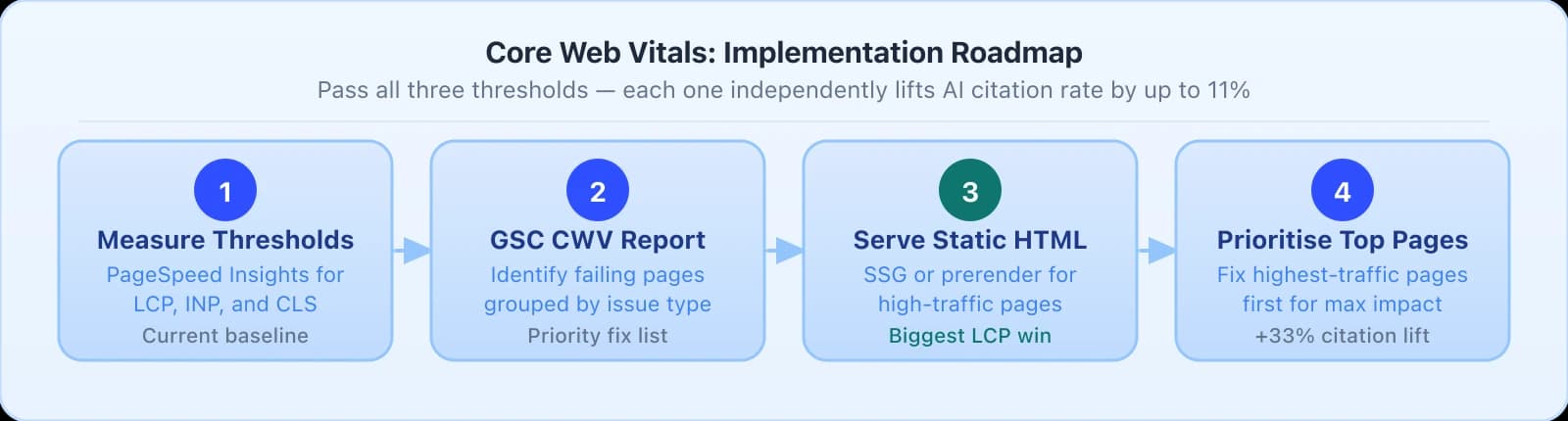
Achieve LCP under 2.5 seconds, INP under 200ms, and CLS under 0.1 for pages targeting Google AI Overviews: Google's documentation confirms these thresholds are prerequisites for standard search performance, which gates AI Overview eligibility.
Use Google Search Console's Core Web Vitals report to identify failing URLs: prioritise fixing pages closest to ranking in the top 10 for their target queries, since top-10 ranking is the primary gateway to AI Overview citation.
Serve content as static HTML or pre-rendered pages: this addresses both Core Web Vitals (faster LCP from no JavaScript execution) and AI crawler access (five of seven AI crawlers cannot render JavaScript) simultaneously.
For Perplexity or ChatGPT targeting, focus on robots.txt allowlisting and static HTML availability instead of Core Web Vitals: those platforms index independently of Google and Core Web Vitals have no confirmed effect on their citation rates.
Frequently asked questions
Does optimising Core Web Vitals and page speed help you get cited in AI search results?
Yes: high confidence across 3 sources (score: 16.0/35). 3 are platform-official: the strongest possible signal. No contradicting evidence found.
Does optimising Core Web Vitals and page speed work for ChatGPT, Perplexity, and Google AI Overviews?
The research covers google-aio. Platform-official guidance exists for this tactic: the strongest possible confirmation. Results may vary by platform as AI systems evolve: verify against current documentation before acting.
How was the evidence collected?
The 3 sources use official platform documentation. All sources are listed with direct links in the Sources section below.
Should I prioritise Optimise Core Web Vitals and page speed over other GEO tactics?
Given the high confidence rating and platform-official backing, yes: this is one of the better-evidenced tactics in the database. Unlike content tactics, this is binary: either your technical setup passes the bar or it doesn't. Audit first, fix second. Technical debt here blocks every downstream optimisation.
How this score is calculated
Each source is weighted by tier, independence, and how recent it is. Open the breakdown to see every source and how the score has changed over time.
Sources
Google upgrades AI Mode in the Chrome browser
Platform officialGoogle·
Understanding Core Web Vitals and Google search results
Platform officialGoogle·
Understanding Google Page Experience
Platform officialGoogle·
Last reviewed: Evidence score: 16.0 / 353 supporting · 0 contradicting